The Unfair Advantage: How Agentic AI Scales Early Careers
Join Our WhatsApp Channel for Latest Updates
1. Defining the Agentic Leap: Chatbots vs. Autonomous Agents
To leverage this shift, you have to understand the architectural leap that occurred over the last year. Traditional generative AI models are purely reactive; they are locked within a single chat window, waiting for your next keystroke.
The Rise of Multi-Step Execution Frameworks
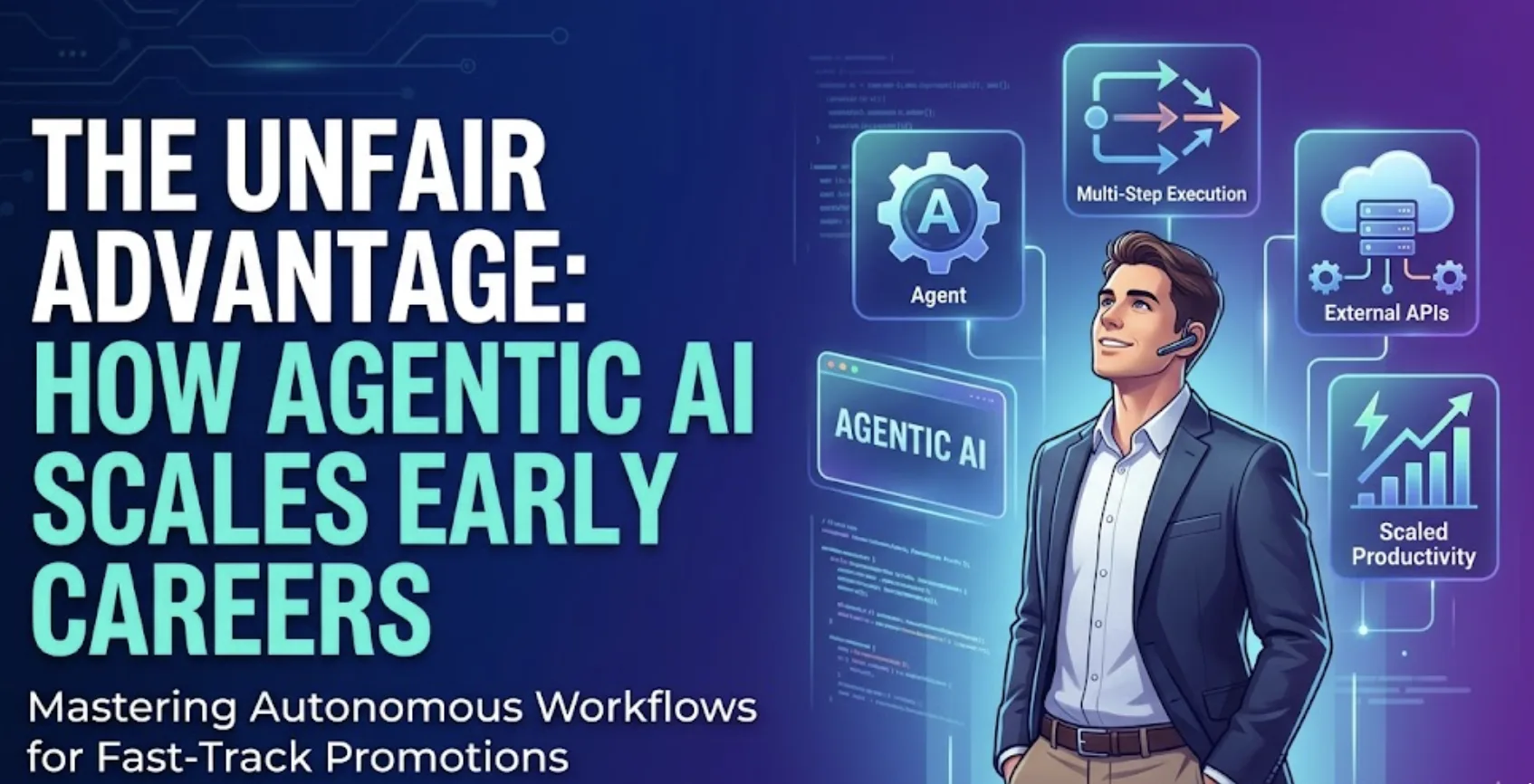
Agentic AI systems operate on an entirely different philosophy: goal-driven autonomy. Instead of asking an AI to "write a Python script to scrape this website," a modern engineer deploys an autonomous agent with a high-level target: "Analyze our competitor’s pricing changes weekly, update our central SQL database, and flag significant anomalies directly in our team Slack." The system breaks down the goal into individual micro-tasks, calls external APIs, tests its own code, fixes its bugs, and delivers a completed business outcome.
Standardizing the Modern AI Ecosystem
This massive leap in capability is powered by major backend shifts, such as the widespread adoption of Model Context Protocol (MCP) servers. MCP standardizes how complex Large Language Models securely connect with localized data sources and developer workflows. This means agents aren't just predicting the next word in a sentence; they are actively orchestrating real-world digital ecosystems.
2. Transforming Developer Workflows and Data Engineering
If you work in software engineering, DevOps, or data science, the integration of autonomous agents completely rewrites your daily task list. The focus is moving swiftly away from manual, repetitive syntax writing to high-level architecture validation.
Autonomous Debugging and Code Orchestration
In a traditional developer environment, tracking down a memory leak or an API bottleneck could consume an entire afternoon. In 2026, advanced software engineering teams use autonomous agents integrated directly into continuous integration/continuous deployment (CI/CD) pipelines. These systems monitor performance drops in real-time, spin up temporary sandboxes to isolate broken microservices, write the structural patch, and submit a pull request for human review—all before an engineer opens their laptop.
Streamlining Data Engineering Pipelines
Data pipelines are notoriously fragile. A sudden change in a third-party application's data schema can easily crash a company's entire analytics dashboard. Agentic AI systems act as self-healing layer mechanisms within data engineering networks. When an ingestion error occurs, the agent detects the structural deviation, automatically remaps the incoming data variables, and alerts the business intelligence leaders without interrupting the underlying system infrastructure.
3. The Shift in Marketing, Sales, and Growth Operations
The impact of Agentic AI isn't confined to technical departments. Non-technical corporate functions are experiencing a major operational overhaul as autonomous execution replaces manual software routing.
Hyper-Personalized, Autonomous Outbound Strategy
Traditional marketing automation relies on highly rigid email drip campaigns that feel robotic and cold. Growth teams in 2026 deploy intelligent agents that continuously scan market signals, corporate press releases, and open-source data. The agent autonomously drafts highly specific, contextual B2B sales outreach messages based on real-time business changes, completely eliminating the need for cold-calling scripts.
Real-Time Competitive Analytics
Instead of waiting for a monthly marketing report, businesses utilize specialized agents to track market shifts as they happen. These models continuously audit competitor ad spends, watch keyword shifts, evaluate consumer sentiment metrics across digital platforms, and automatically adjust localized digital advertising budgets to maximize corporate ROI.
4. Avoiding the Trap of "Technostress" and FOBO
With workplace automation scaling at an unprecedented rate, a new psychological challenge has gripped the modern corporate environment: Fear of Becoming Obsolete (FOBO).
Mitigating the Digital Overwhelm
When AI tools can spin up entire marketing campaigns or write functional software code in seconds, professionals often experience severe workplace anxiety and technostress. The volume of digital data generated can easily overwhelm a team's capacity. Overcoming this requires building explicit professional boundaries around your digital workspaces.
Shifting from Creation to Governance
The secret to beating FOBO is recognizing that as AI handles baseline creation, the demand for human governance, strategic reasoning, and ethical oversight skyrockets. Companies do not need you to compete with an autonomous agent's processing speed; they need you to evaluate whether the agent's output aligns with corporate compliance standards, brand values, and overarching business objectives.
Industry Insight: Leading human resource experts emphasize that the most valuable corporate assets in 2026 are not technical purists, but "AI-adjacent talent"—professionals who can orchestrate workflows, interpret automated outputs, and handle cross-functional stakeholder alignment.
5. How to Future-Proof Your Career Architecture
To build an elite professional trajectory today, you must position yourself as the director of the automation, rather than its assistant.
Developing Core Systems Thinking
To stand out to executive leadership, you need to develop deep systems thinking. You must learn how various automated systems interact across different departments. If you understand how an AI tool in customer success maps back to data layers in the product development team, you stop being an execution clerk and instantly become a vital business transformation manager.
Cultivating Radical Adaptability
The technical tools used today may be upgraded or entirely replaced by next quarter. Cultivating a growth mindset and maintaining a high level of career adaptability is your absolute baseline shield against workplace automation. Commit to continuous upskilling, learn the basics of cloud security, and master the data fundamentals that govern modern tech stacks.
[Read More: Top Skills Employers Want to See on Your Resume Right Now]
FAQ: Surving the Agentic AI Workforce Transformation
Q: Does the rise of Agentic AI mean prompt engineering is a dead skill?
A: Simple single-line prompting is declining in corporate value. The skill has transformed into "agent orchestration"—understanding how to define clear operational constraints, design multi-agent workflows, and build secure parameters for autonomous systems.
Q: Will autonomous AI agents completely replace entry-level software developers?
A: No, but they are dramatically altering what an entry-level role looks like. Instead of writing basic boilerplate code, freshers are expected to act as code reviewers, system testers, and integration specialists, requiring a higher level of critical thinking earlier in their careers.
Q: How can I safely test Agentic AI tools without compromising company data?
A: Always respect your organization's internal data governance policies. Utilize localized sandboxes, ensure compliance with enterprise data privacy frameworks, and never input proprietary source code or sensitive client metrics into unverified open-source models.
Q: What specific technical skills should I focus on to work with these systems?
A: Focus heavily on data fluency and infrastructure basics. Mastering SQL, understanding Python fundamentals, learning how APIs communicate, and gaining certifications in core cloud platforms (like AWS or Azure) will give you a major competitive advantage.
Q: How do I talk about my AI orchestration skills in a job interview?
A: Avoid generic phrases like "AI enthusiast." Frame your experience using concrete business metrics. Explain how you configured an autonomous workflow, the data pipelines it connected to, and the measurable time or cost savings it delivered to your previous team.