

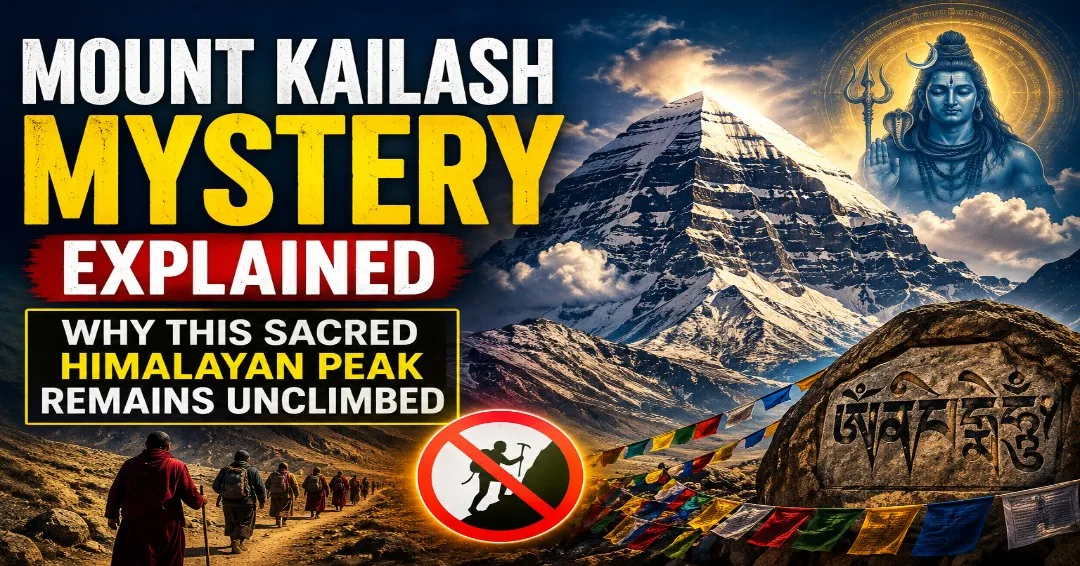
Mount Kailash Mystery Explained: Why This Sacred Himalayan Peak Remains Unclimbed
Join Our WhatsApp Channel for Latest UpdatesThe Mystery of Mount Kailash: Why Nobody Has Ever Reached the Summit of the World's Most Sacred Mountain
Introduction
Imagine a mountain so sacred that humanity has chosen not to conquer it.
For centuries, explorers have climbed the world's highest peaks. Mount Everest, K2, and countless other mountains once thought impossible have all been conquered.
Yet hidden deep within the Himalayas stands a mountain that remains untouched.
Not because humans cannot climb it.
But because they choose not to.
That mountain is Mount Kailash.
For billions of followers of Hinduism, Buddhism, Jainism, and Bon traditions, Mount Kailash is not just a mountain. It is a sacred symbol, a spiritual center, and one of the holiest places on Earth.
What makes Kailash truly extraordinary is a fact that continues to puzzle researchers, historians, and travelers:
No officially recognized human being has ever reached its summit.
Even in an era of satellites, helicopters, advanced climbing gear, and modern mountaineering, the peak remains untouched.
Why?
- Is the mountain too dangerous?
- Is climbing prohibited for religious reasons?
- Or is there a deeper mystery hidden within the legends of Kailash?
Let's explore one of the greatest mysteries of the Himalayas.
Quick Facts About Mount Kailash
| Fact | Details |
|---|---|
| Location | Tibet Autonomous Region, China |
| Elevation | 6,638 meters (21,778 feet) |
| Mountain Range | Transhimalaya |
| Sacred To | Hinduism, Buddhism, Jainism, Bon |
| Known As | Abode of Lord Shiva |
| Summit Record | No Official Ascent |
| Famous Pilgrimage | Kailash Parikrama |
| Annual Visitors | Thousands of Pilgrims |
Why Is Mount Kailash So Sacred?
Unlike most famous mountains, Mount Kailash is revered not for its height but for its spiritual significance.
In Hinduism
Mount Kailash is believed to be the eternal home of Lord Shiva and Goddess Parvati.
Ancient scriptures describe it as the center of the universe, where Shiva meditates and governs the cycle of creation and destruction.
In Buddhism
Buddhists associate Kailash with Demchok, a deity representing enlightenment and supreme bliss.
In Jainism
Jains believe that Rishabhadeva, the first Tirthankara, attained liberation near Mount Kailash.
In Bon Religion
Followers of the ancient Bon faith consider Kailash to be the spiritual axis of the world.
Because of this immense spiritual importance, pilgrims do not seek to conquer the mountain.
Instead, they perform the sacred Kailash Parikrama, a journey around its base believed to bring spiritual purification and blessings.
The Mountain Humanity Never Conquered
Human history is filled with stories of exploration and conquest.
- Mount Everest was first climbed in 1953
- K2 has been successfully summited
- Humans have walked on the Moon
Yet Mount Kailash remains untouched.
Several climbers have expressed interest in attempting an ascent over the years.
However, permits have generally been denied due to the mountain's religious significance.
Even many of the world's greatest mountaineers have publicly stated that they would never attempt to climb Kailash out of respect for the billions of people who consider it sacred.
In a world where humans have reached the deepest oceans and walked on the Moon, Mount Kailash remains one of the last great untouched frontiers.
The Perfect Pyramid of the Himalayas
One of the first things visitors notice about Mount Kailash is its unusual appearance.
Unlike many rugged Himalayan peaks, Kailash rises in an almost perfect pyramid-like shape.
Its steep faces, sharp ridges, and snow-covered summit create an appearance that seems almost too perfect to be natural.
Popular Claims
- It is a giant ancient pyramid
- It possesses hidden energies
- It is connected to unknown civilizations
Scientists, however, explain that natural geological processes can create surprisingly symmetrical mountain formations over millions of years.
Still, its appearance continues to fuel speculation and mystery.
The Ancient Legend of Milarepa
Among the many legends surrounding Kailash, one story stands above the rest.
According to Tibetan Buddhist tradition, a saint named Milarepa once competed against a Bon master in a spiritual contest.
The Challenge
Whoever reached the summit first would prove the superiority of their spiritual path.
Legend says Milarepa used supernatural powers gained through meditation to ascend the mountain and emerge victorious.
Whether this story is historical or symbolic remains unknown.
But it continues to be one of the most fascinating legends associated with Mount Kailash.
Why Is Climbing Mount Kailash Forbidden?
The biggest reason nobody climbs Mount Kailash today is surprisingly simple:
Respect.
Religious leaders from multiple faiths believe the summit should remain untouched.
To many believers, standing on top of Kailash would be equivalent to entering a sacred sanctuary.
During the late twentieth century, discussions about climbing expeditions took place.
However, strong opposition from religious communities ensured that restrictions remained in place.
As a result, Mount Kailash has become a rare example of humanity choosing reverence over conquest.
Theories Behind the Mystery
Theory #1: Religious Protection
The most accepted explanation.
The mountain remains unclimbed because billions of people consider it sacred.
Theory #2: Extreme Terrain
Experts believe the mountain's steep slopes, harsh weather, and remote location would make any ascent extremely difficult.
Theory #3: Strange Experiences Reported by Pilgrims
Many visitors claim unusual experiences near Kailash.
Some report:
- Vivid dreams
- Spiritual awakenings
- Altered perceptions of time
- Feelings of overwhelming peace
While science has found no evidence of supernatural phenomena, these stories continue to strengthen the mountain's mystique.
Theory #4: The Cosmic Mountain Theory
Ancient traditions often describe Kailash as the center of the universe.
Modern enthusiasts have linked these beliefs to theories involving:
- Sacred geometry
- Energy fields
- Ancient civilizations
- Unknown natural phenomena
There is currently no scientific evidence supporting these claims.
What Does Science Say?
Scientists view Mount Kailash as a remarkable combination of:
- Geology
- History
- Culture
- Religion
Its unique shape can be explained through natural geological processes.
Its untouched summit, meanwhile, is primarily the result of religious respect and restricted access.
From a scientific perspective, the mystery of Kailash is less about supernatural forces and more about the powerful relationship between human belief and nature.
The Sacred Kailash Parikrama
While climbing is forbidden, pilgrims are encouraged to complete the Kailash Parikrama.
This sacred journey covers approximately 52 kilometers around the mountain.
Many believe that completing a single circuit helps cleanse sins and bring spiritual merit.
Some devotees perform the entire route through full-body prostrations, making it one of the most demanding pilgrimages in the world.
For believers, walking around Kailash is far more meaningful than standing on its summit.
Will Mount Kailash Ever Be Climbed?
Technologically, humanity is capable of attempting the ascent.
But Should It?
That question lies at the heart of the Mount Kailash mystery.
In a world where almost every natural frontier has been explored, Kailash remains a rare reminder that not everything needs to be conquered.
Many believe its sacred status should be preserved forever.
Conclusion
Mount Kailash is more than a mountain.
It is a symbol of faith, mystery, history, and human curiosity.
Its untouched summit, ancient legends, sacred significance, and unique appearance have made it one of the most fascinating places on Earth.
Perhaps the greatest mystery is not why nobody has reached the summit.
Perhaps the real mystery is why humanity has collectively chosen to leave one mountain untouched.