

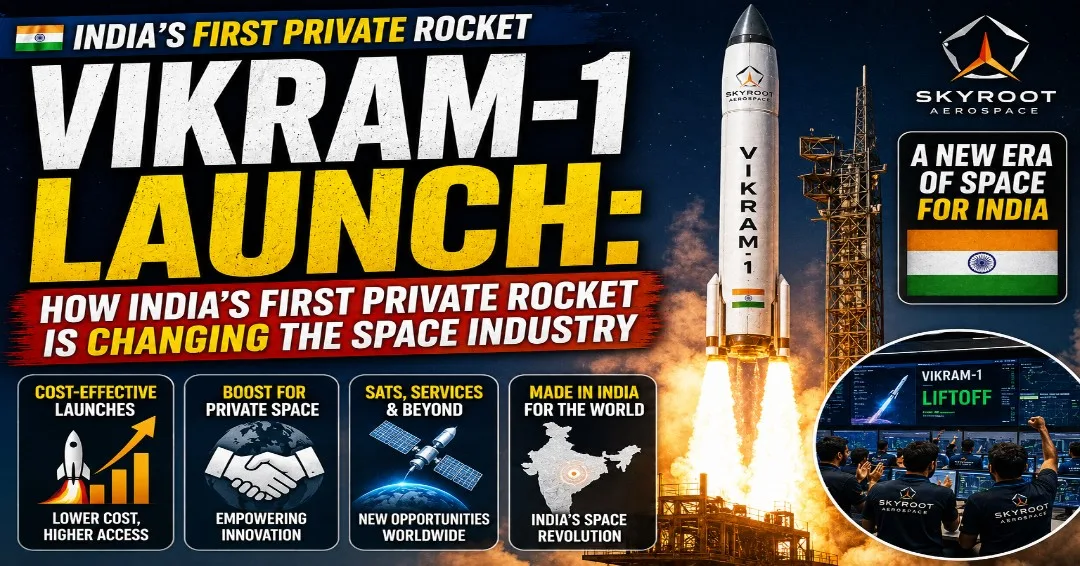
Vikram-1 Launch: How India's First Private Rocket Is Changing the Space Industry
Join Our WhatsApp Channel for Latest UpdatesVikram-1 Launch: How India's First Private Rocket Is Changing the Space Industry
Early Saturday morning, a seven-story rocket built almost entirely by a private Indian company lifted off from the Satish Dhawan Space Centre in Sriharikota — and made it to orbit. Skyroot Aerospace's Vikram-1 is now India's first privately developed orbital launch vehicle to successfully fly, and it makes India only the third country in the world with a private orbital launch capability.
Here's what happened, why it matters, and what it signals for India's fast-growing commercial space sector.
What launched, and when
Vikram-1 lifted off on July 18, 2026, at 2:35 a.m. EDT (12:05 p.m. India Standard Time) under the name Mission Aagaman — Sanskrit for "the arrival." It flew from the same Sriharikota launch complex India's state space agency, ISRO, has used for decades, though this rocket was designed, built, and flown by Skyroot, a Hyderabad-based startup founded in 2018 by former ISRO engineers Pawan Kumar Chandana and Naga Bharath Daka.
The rocket is a 23-meter, all-carbon-composite vehicle with three solid-fuel lower stages and a liquid-fueled upper stage — the Orbit Adjustment Module — that can restart its engine to place multiple payloads into different orbits during a single flight. It's designed to carry up to 480 kilograms to low Earth orbit, aimed squarely at the small-satellite market rather than competing with heavier government rockets like ISRO's PSLV.
Mission director confirmation on launch day: "The Vikram-1 Aagaman mission is a grand success."
Onboard were four working payloads — a satellite from Grahaa Space, a robotic arm from Cosmoserve Space designed to capture orbital debris, a technology demonstrator from DCUBED, and Skyroot's own SCOPE satellite for monitoring the rocket's performance — plus two symbolic items: a flower-shaped artwork and an 18-karat gold micro-rocket engraved with tiny sculptures of Indian scientists C.V. Raman, Vikram Sarabhai, and A.P.J. Abdul Kalam.
Why this launch matters
- It's the culmination of an eight-year bet. Skyroot has spent nearly eight years and raised more than $160 million to get here, including a $1 billion valuation round backed by GIC, Temasek, and BlackRock. The company first proved out its rocket technology with the smaller, suborbital Vikram-S in 2022 — India's first privately built rocket to reach space, though not orbit.
- It validates India's space liberalization experiment. India only opened its space sector to private companies in 2020. Since then, the regulator IN-SPACe has registered more than 4,500 organizations, issued 133 authorizations, and signed over 100 memoranda of understanding with industry players, backed by government funding vehicles like a ₹1,000-crore venture capital fund and liberalized foreign investment rules — up to 74% automatic FDI in satellite manufacturing and 49% in launch vehicles. Vikram-1 is the first orbital proof that this liberalization can produce a working rocket, not just paperwork.
- It's part of a broader ecosystem, not a one-off. Skyroot isn't alone. Chennai-based Agnikul Cosmos launched India's second private rocket in 2024 from its own privately built launchpad — also at Sriharikota — using a largely 3D-printed engine. Other firms like Pixxel (Earth-observation satellites, including a $476 million NASA deal) and Bellatrix Aerospace (satellite propulsion) round out a sector that has grown from a single startup a decade ago to more than 200-400 space companies today.
- The economic ambitions are large. India currently values its space economy at about $8.4 billion — roughly 3% of the global market — and the government wants to grow that fivefold within seven years. A successful, repeatable private orbital launcher is a prerequisite for that kind of growth, since it lets Indian companies compete directly for commercial satellite-launch contracts that currently go elsewhere.
What's next
Mission Aagaman is described as the first of three planned development flights meant to validate Vikram-1 before Skyroot moves to commercial operations. That phased approach mirrors how other new launch vehicles typically prove reliability before airlines, satellite operators, and governments trust them with expensive payloads.
Longer term, Skyroot has already outlined a heavier successor, Vikram-II, designed to carry up to 900 kilograms to orbit using a cryogenic upper stage and further 3D-printed propulsion technology — suggesting Vikram-1 is meant as a first step rather than an end point.
For India's space sector as a whole, the real test now is repeatability and cost: whether Skyroot and its private-sector peers can turn a single successful flight into a reliable, commercially competitive launch cadence — the same transition SpaceX made over a decade ago, and one that would let India capture a meaningfully larger share of the global small-satellite launch market it's chasing