
Global Heatwaves 2026: Which Countries Are Most Affected?
Join Our WhatsApp Channel for Latest UpdatesGlobal Heatwaves 2026: Which Countries Are Most Affected?
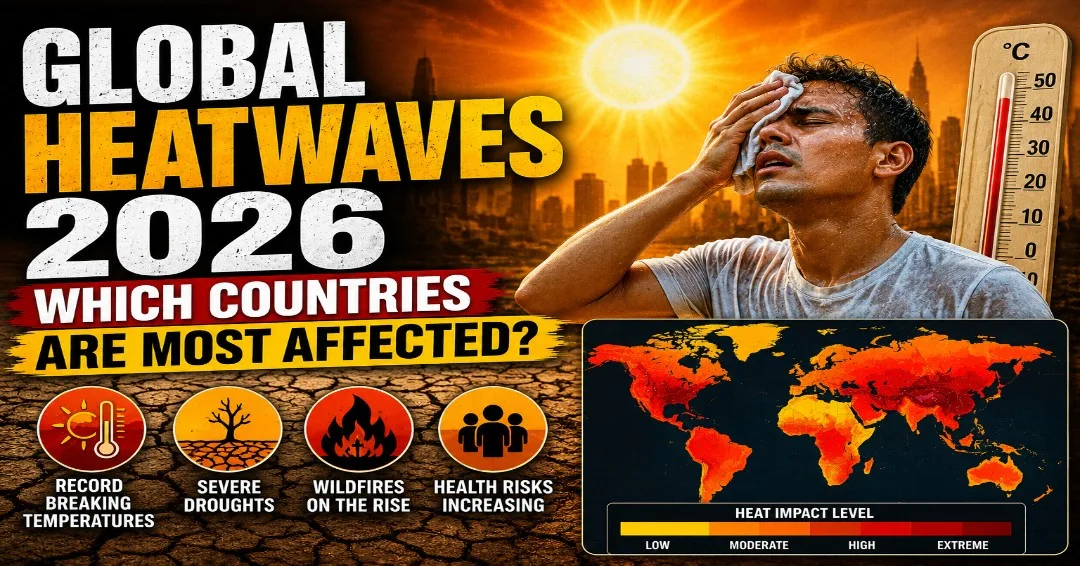
2026 has turned into one of the most brutal years for extreme heat in recorded history. Barely a season has passed without a new temperature record falling somewhere on the planet — from the plains of India in April, to the streets of Paris in June, to the boardwalks of the New Jersey shore in July. Here's a region-by-region look at where the heat has hit hardest, and why.
Europe: The Epicenter of 2026's Heat Crisis
No region has suffered more than Europe this year. A string of three major heatwaves — starting in late May, intensifying through June, and continuing into July — has left the continent reeling.
France has arguably taken the hardest hit. Météo-France declared June 23 the country's hottest day since records began in 1947, with the town of Pissos reaching 44.3°C (111.7°F). Paris itself set a June record of 40.9°C. France's public health agency reported roughly 1,000 excess deaths in a single week in late June alone, with drownings — as people sought relief in rivers and lakes — a leading cause.
Spain wasn't far behind. AEMET, the national weather agency, recorded a peak of 45.1°C in Andújar on June 22, and the Fabra Observatory in Barcelona logged 40.5°C on July 8 — its hottest reading in over a century of data.
Germany broke its all-time national heat record three days running in June, finally topping out at 41.7°C at Coschen. The United Kingdom issued a rare red extreme-heat warning as its June record fell (37.7°C), and by mid-July had recorded eight separate days above 34°C — a new national record for a single year.
At least 13 European countries broke national or monthly temperature records this year, including Belgium, Switzerland, Denmark, Austria, Hungary, Czechia, Poland, Italy, and the Netherlands. Belarus recorded its first-ever reading above 40°C.
The human toll has been staggering. The World Health Organization's initial estimate put excess deaths at over 1,300 in the last week of June alone. A more recent, not-yet-peer-reviewed academic estimate puts total June deaths across the continent above 20,000, with Germany (~5,100), France (~5,200 in one estimate), Spain, and Italy among the hardest hit. Scientists at World Weather Attribution concluded that the temperatures recorded would have been "virtually impossible" without human-caused climate change — comparing today's odds to what they would have been in 1976.
Beyond the death toll, the heat has strained power grids, sent electricity prices spiking in Belgium and the Netherlands, forced restrictions on French nuclear plants that rely on river water for cooling, and fueled major wildfires in Spain (7,000 hectares burned near Almería) and France (a fire near the Fontainebleau Forest that triggered evacuations).
South Asia: A "Regular Reality" of Deadly Heat
While Europe's crisis dominated headlines by summer, South Asia was already in the grip of extreme heat months earlier. From mid-April through May, India and Pakistan saw daily highs top 46°C in numerous cities — 5 to 8°C above seasonal norms — with Bangladesh also affected.
In Karachi, Pakistan's most populous city, temperatures hit 44°C, the highest since 2018, and at least 10 heat-related deaths were recorded. In India, at least 37 heat-related deaths were reported, though experts warn the true toll is likely far higher, since heat deaths are systematically undercounted in the country.
World Weather Attribution scientists found that climate change made this heatwave roughly three times more likely and about 1°C hotter than it would have been in a pre-industrial climate — and that such extremes, once rare, are now expected about once every five years in the region. The event also drove record electricity demand in India and worsened drought across more than a million square kilometers of farmland.
What makes South Asia's heat especially dangerous is humidity. High wet-bulb temperatures mean the body can't cool itself through sweating, and researchers note that even healthy adults face real danger at 45°C combined with just 30% humidity. Outdoor laborers and daily-wage workers — who make up a huge share of the workforce — bear the brunt, since staying indoors isn't an option.
North America: Records Falling from Arizona to Quebec
The United States and Canada have faced their own extraordinary run of heat in 2026, starting with a bizarre March heat dome that pushed Denver to 85°F (when normal highs are around 55°F) and gave San Francisco its hottest March day in 152 years — an event World Weather Attribution called "virtually impossible" without climate change.
The bigger story came in late June and into July, when a heat dome settled over the eastern U.S. and Canada, coinciding with the FIFA World Cup and the July 4th holiday. Atlantic City, New Jersey tied its all-time record at 106°F (41°C). Philadelphia recorded three straight days above 101°F for the first time in its history. New Jersey alone linked at least 25–26 deaths to the heat, and the broader North American event has been blamed for over 40 deaths as of early July. In Canada, Ontario and Quebec faced heat warnings alongside Canada Day storms that knocked out power to tens of thousands of homes.
Australia and the Southern Hemisphere
Australia rang in 2026 with one of its most severe heatwaves in years. In late January, a record-breaking heat dome pushed temperatures as high as 50°C (122°F) in parts of South Australia, with Melbourne and Sydney both topping 40°C during a heatwave described as the country's worst since 2019.
Argentina also faced an unusually intense heatwave in late January, with temperatures hitting 40°C and threatening livestock and crop yields — a reminder that the Southern Hemisphere's summer months carry their own escalating heat risk.
Why 2026 Has Been So Extreme
A few forces have combined to make this year stand out:
- El Niño conditions, confirmed by the WMO in June, have been building toward what some scientists warn could be one of the strongest events on record, amplifying heat and disrupting weather patterns globally.
- Record sea surface temperatures — the highest ever recorded for the month of June — have added extra energy and moisture into the atmosphere.
- Persistent "heat dome" and "omega block" patterns have caused hot air to stall over the same regions for days or weeks at a time, preventing the kind of relief that a passing weather system would normally bring.
Underlying climate change remains the throughline. Attribution scientists have repeatedly found that this year's most extreme events — in South Asia, Europe, and North America alike — would have been extremely rare or essentially impossible without human-driven warming.
The Bottom Line
No single country has a monopoly on 2026's heat crisis — it's been a genuinely global story, with France, Spain, and Germany in Europe, India and Pakistan in South Asia, and the United States in North America among the hardest and most visibly hit. What connects them is a pattern experts have been warning about for years: heatwaves that were once "once-in-a-generation" events are now arriving nearly annually, hitting harder, lasting longer, and killing more people — particularly the elderly, outdoor workers, and those without access to cooling.
Note: Death tolls and temperature figures in this article reflect the most recent data available as of mid-July 2026 and are likely to be revised as the year continues.