

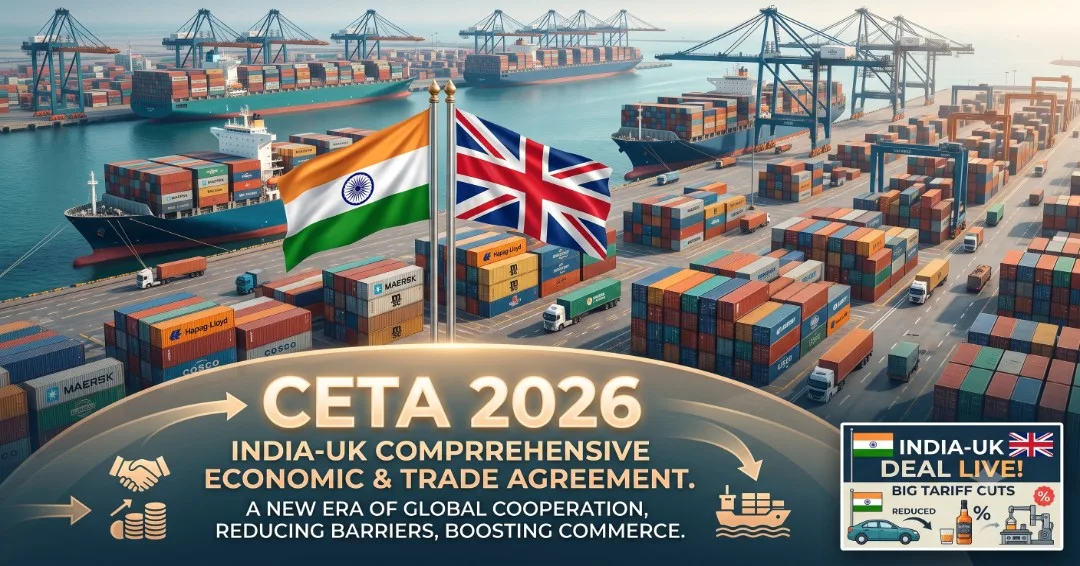
India-UK Trade Deal CETA Kicks In: Tariffs, Benefits, IT Sector Impact
Join Our WhatsApp Channel for Latest UpdatesThe India-UK Comprehensive Economic and Trade Agreement (CETA) Comes into Force: A New Era for Exports and Careers
July 15, 2026, marks one of the most significant milestones in India's international trade history. The highly anticipated India-UK Comprehensive Economic and Trade Agreement (CETA) has officially come into force, transforming the bilateral economic landscape between two of the world's most dynamic markets.
The landmark deal, which is the Modi government's sixth implemented free trade agreement, completely eliminates tariffs on nearly 99% of Indian exports to the United Kingdom. Concurrently, a parallel social security treaty—the India-UK Double Contributions Convention (DCC)—has been activated to provide massive financial relief to temporary Indian workers in the UK.
In this comprehensive report, CareerFlora breaks down the massive tariff changes, the sectors set to strike gold, and what this historic agreement means for Indian professionals, students, and businesses.
Latest Verified Information: What is Changing on July 15, 2026?
With CETA officially active today, the immediate impact is a sweeping reduction in tariffs and import duties across thousands of product categories.
- 99% Duty-Free Access for India: Over 99% of Indian exports entering the United Kingdom will now enjoy completely tariff-free, duty-free entry. This is expected to provide an immediate boost to highly labor-intensive Indian sectors.
- UK Product Concessions: In return, India is systematically lowering import tariffs on several key UK products. This includes premium British automobiles, machinery, and highly sought-after British alcoholic beverages, including Scotch whisky.
Excluded Sensitive Sectors: To protect domestic industries, both nations have maintained strict exclusions on highly sensitive items. For India, import concessions do not apply to products like apples, walnuts, smartphones, and gold bars.
Detailed Explanation: The Social Security Relief (DCC)
For skilled Indian professionals—especially IT engineers, financial consultants, and project managers sent to work temporarily in the UK—today brings a monumental financial victory.
Under the newly active Double Contributions Convention (DCC), temporary Indian professionals working on a "detached worker" status in the UK are entirely exempt from paying social security contributions (known in the UK as National Insurance) for up to 60 months (5 years).
Previously, this exemption was limited to just 12 months. This change keeps thousands of pounds in the pockets of Indian professionals, lowering the cost of global talent deployment for Indian IT firms like TCS, Infosys, and Wipro.
Note on Retrospectivity: The DCC is strictly not retrospective. It will apply only to workers sent to the host country on or after July 15, 2026; professionals who were already working in the UK before this date will not be eligible to claim historical social security exemptions.
Important Facts: Key Beneficiary Sectors in India
The elimination of tariffs opens up immense economic expansion and job creation opportunities across several key Indian sectors:
- Textiles and Garments: India's textile hubs (like Tiruppur and Surat) can now compete directly with Southeast Asian nations on a level playing field in the UK market.
- Footwear and Leather Goods: Zero-duty access will immediately lower retail prices for Indian leather products in premium London outlets.
- Automobiles and Engineering: Indian component manufacturers can now integrate seamlessly into the UK automotive supply chain.
Agriculture and Processed Food: High-quality Indian tea, spices, and organic produce will face zero entry barriers.
Timeline of the Historic Treaty
- July 25, 2025: After dozens of rounds of grueling negotiations, India and the UK officially sign the Comprehensive Economic and Trade Agreement (CETA).
- Late 2025 - Early 2026: Parliaments of both nations formally ratify the agreement and execute structural policy updates.
July 15, 2026: CETA and the Double Contributions Convention officially come into force.
Expert Analysis: A Win-Win Geopolitical Landmark
Bilateral trade experts point out that the India-UK trade deal is the most "ambitious and aspirational" free trade agreement India has signed with a major G7 country. It signals to the Western world that India is ready for deep, structural economic integration with high-income economies.
For the UK, the treaty offers immediate, lucrative access to India's booming consumer class, while for India, it solidifies our role as a major exporter of high-quality manufactured goods and tech services.
Future Career and Educational Impact
For Indian students planning to study in the UK, or young professionals looking for global mobility, the deal is highly encouraging:
- Smoother Corporate Transfers: The expansion of the social security relief to 60 months makes it much cheaper for Indian companies to sponsor long-term professional postings in the UK.
Professional Services Mutual Recognition: Ongoing parallel discussions under CETA aim to streamline the mutual recognition of professional qualifications, meaning Indian degrees in architecture, accounting, and engineering may soon be directly recognized in the UK without additional certification exams.
FAQs
Q: Does the India-UK CETA lower the price of Scotch whisky in India?
A: Yes. India will systematically and gradually reduce the high import tariffs on Scotch whisky and other premium UK spirits, leading to lower prices for consumers.
Q: Is the new 60-month social security exemption applicable to Indians already working in the UK?
A: No, the Double Contributions Convention (DCC) is not retrospective. It applies only to workers dispatched on or after the implementation date of July 15, 2026.
Q: Are smartphones or electronics cheaper because of this trade deal?
A: No. Sensitive electronic categories, including smartphones, remain outside of the tariff concessions under CETA to protect India's domestic manufacturing ecosystem.
Conclusion
The implementation of the India-UK CETA on July 15, 2026, is a watershed moment for global trade. By slashing tariffs on 99% of Indian exports and securing a five-year tax holiday on social security for our IT professionals, the treaty builds a golden bridge between New Delhi and London. Keep tracking CareerFlora for deeper economic reviews, job trends in global trade, and international admission updates.