How Google Search Works: Crawling, Indexing, and Ranking Explained
Join Our WhatsApp Channel for Latest UpdatesHow Google Search Works: Crawling, Indexing, and Ranking Explained
Every second, Google processes thousands of search queries from users around the world. Whether you're searching for the latest news, a programming tutorial, or a nearby restaurant, Google delivers highly relevant results almost instantly.
But have you ever wondered how Google manages to search through billions of web pages in just a fraction of a second?
The answer lies in three fundamental processes:
- Crawling
- Indexing
- Ranking
Together, these processes form the backbone of Google's search engine.
In this article, we'll explore exactly how Google Search works.
What Is Google Search?
Google Search is a search engine designed to organize and retrieve information available on the World Wide Web.
Its primary goal is simple:
Provide users with the most relevant and useful information as quickly as possible.
To accomplish this, Google continuously discovers, analyzes, and organizes web pages from across the internet.
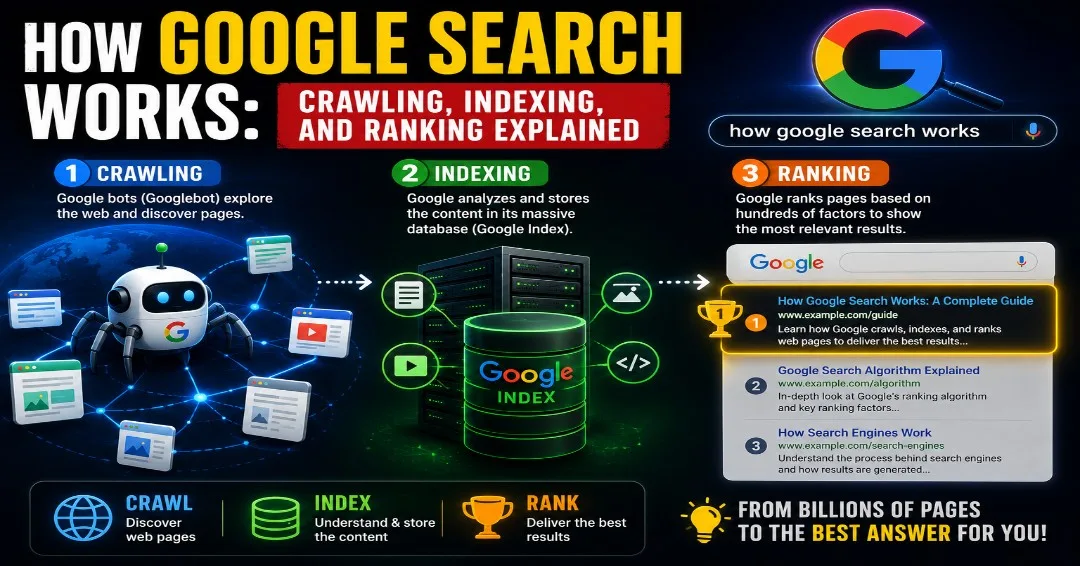
Step 1: Crawling — Discovering Web Pages
Before Google can show a webpage in search results, it must first discover that page.
This process is known as Crawling.
Google uses automated software programs called:
Googlebots
Googlebots, also known as web crawlers or spiders, continuously browse the web by following links from one page to another.
For example:
Website A → Website B → Website C
If Website A links to Website B, Google's crawler may follow that link and discover Website B.
Googlebots continuously:
- Discover new pages
- Revisit existing pages
- Detect updated content
- Identify deleted pages
Without crawling, Google would never know a webpage exists.
How Google Finds New Pages
Google discovers pages through multiple methods:
1. Following Links
Links between websites help Google navigate the web.
2. XML Sitemaps
Website owners can submit XML sitemaps that list important pages.
Example:
https://example.com/sitemap.xml
3. Manual URL Submission
Website owners can request indexing through Google Search Console.
Step 2: Indexing — Storing Information
After discovering a webpage, Google analyzes its content.
This process is called Indexing.
Google attempts to understand:
- Text content
- Images
- Videos
- Titles
- Headings
- Meta descriptions
- Structured data
- Internal links
Google then stores this information in a massive database called:
Google Index
Think of the Google Index as a gigantic digital library containing information from billions of web pages.
If a page is not indexed, it cannot appear in search results.
What Can Prevent Indexing?
Several factors may stop Google from indexing a page:
noindextags- Blocked robots.txt rules
- Poor-quality content
- Duplicate pages
- Server errors
Website owners can monitor indexing status using Google Search Console.
Step 3: Ranking — Choosing the Best Results
Once pages are indexed, Google must determine:
Which pages should appear first?
This process is known as Ranking.
Google uses sophisticated algorithms to evaluate and rank pages.
When a user searches:
best laptops for students
Google may analyze millions of pages before selecting the most relevant results.
Ranking Factors Used by Google
Google uses hundreds of ranking signals.
Some important factors include:
Content Relevance
Does the content match the user's search intent?
Content Quality
Is the information accurate, comprehensive, and useful?
Backlinks
Links from reputable websites often indicate trust and authority.
Page Experience
Google evaluates:
- Mobile friendliness
- Loading speed
- Security (HTTPS)
- User experience
Freshness
For news-related topics, newer content may receive preference.
Understanding Search Intent
Modern Google algorithms focus heavily on understanding user intent.
Search intent generally falls into four categories:
| Intent | Example |
|---|---|
| Informational | How does AI work? |
| Navigational | Facebook login |
| Transactional | Buy iPhone online |
| Commercial | Best laptops under ₹50,000 |
Understanding search intent is essential for SEO.
How Google Understands Language
Google increasingly relies on Artificial Intelligence.
Technologies such as:
- RankBrain
- BERT
- Neural Matching
help Google better understand:
- Context
- Synonyms
- User intent
- Natural language
This enables Google to provide more accurate search results.
Why SEO Matters
SEO (Search Engine Optimization) is the practice of improving webpages so that search engines can better crawl, index, and rank them.
Effective SEO helps:
- Increase organic traffic
- Improve visibility
- Reach targeted audiences
- Build authority
Good SEO focuses on creating valuable content for users rather than manipulating search algorithms.
Complete Google Search Workflow
Website Published
        ↓
Googlebot Discovers Page
        ↓
Page Crawled
        ↓
Content Analyzed
        ↓
Page Indexed
        ↓
User Searches Query
        ↓
Google Algorithms Evaluate Results
        ↓
Best Pages Ranked
        ↓
Search Results Displayed
Final Thoughts
Google Search may appear simple from the user's perspective, but behind the scenes it involves an incredibly sophisticated system of crawling, indexing, and ranking billions of webpages.
Understanding how Google Search works is essential for website owners, SEO professionals, developers, and anyone interested in the technology powering the modern internet.
As search technology continues to evolve, Artificial Intelligence will play an even greater role in shaping the future of information discovery.
Frequently Asked Questions (FAQs)
What is Googlebot?
Googlebot is Google's automated web crawler that discovers and scans webpages.
What is indexing in Google?
Indexing is the process by which Google stores and organizes webpage information in its database.
What is ranking?
Ranking is the process of determining the order in which webpages appear in search results.
How long does Google take to index a page?
Indexing may take anywhere from a few hours to several weeks depending on various factors.
Can a webpage appear in Google without being indexed?
No. A webpage must be indexed before it can appear in Google Search results.