
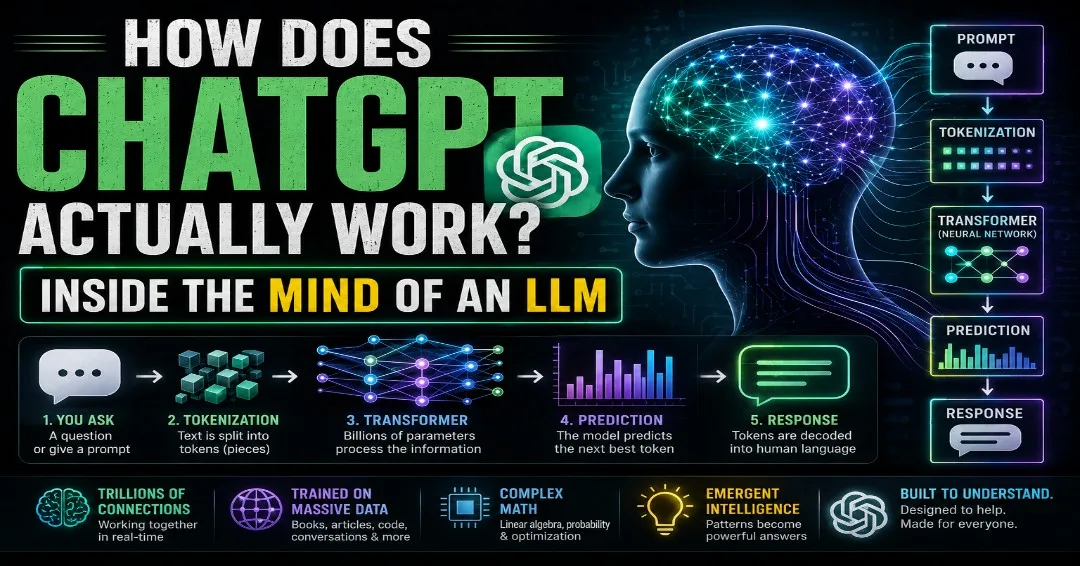
How Does ChatGPT Actually Work? Inside the Mind of an LLM
Join Our WhatsApp Channel for Latest UpdatesHow Does ChatGPT Actually Work? Inside the Mind of an LLM
Artificial Intelligence has transformed the way humans interact with technology. From writing essays and generating code to answering complex questions, AI systems such as ChatGPT have become incredibly powerful. But have you ever wondered what actually happens behind the scenes when you ask ChatGPT a question?
How can a machine generate human-like responses within seconds?
The answer lies in a fascinating combination of mathematics, neural networks, massive datasets, and a revolutionary architecture known as the Transformer.
In this article, we'll explore how ChatGPT works in simple terms.
What Is ChatGPT?
ChatGPT is a conversational AI developed by OpenAI. It belongs to a category of AI systems called Large Language Models (LLMs).
An LLM is an artificial intelligence model trained on enormous amounts of text data, enabling it to understand patterns in human language and generate coherent responses.
Unlike traditional software, ChatGPT isn't programmed with fixed answers. Instead, it predicts the most likely sequence of words based on the context it receives.
Step 1: Breaking Text into Tokens
Computers cannot directly understand words.
When you type:
"How does ChatGPT work?"
the AI first breaks the sentence into smaller units called tokens.
A token can be:
- A complete word
- Part of a word
- A punctuation mark
- A single character
Example:
How | does | Chat | GPT | work | ?
Tokens are the basic building blocks that the model processes.
Step 2: Converting Words into Numbers
Computers only understand numbers.
Therefore, every token is converted into a numerical representation called an embedding.
Embeddings allow the AI to represent relationships between words mathematically.
For example:
- King and Queen have similar embeddings.
- Paris and France are closely related.
- Apple can represent either a fruit or a company depending on context.
This mathematical representation enables AI to capture meaning rather than merely memorizing text.
Step 3: The Transformer Architecture
The biggest breakthrough behind ChatGPT is the Transformer architecture, introduced in 2017 in the landmark research paper:
"Attention Is All You Need"
Transformers revolutionized AI by allowing models to understand relationships between words regardless of their position in a sentence.
For example, in the sentence:
"The animal didn't cross the road because it was tired."
The model understands that "it" refers to "the animal."
This ability is powered by a mechanism called Attention.
Step 4: Understanding Context with Attention
Attention allows the model to determine which words are most important when generating a response.
Consider the sentence:
"The cat sat on the mat because it was soft."
The model analyzes all words simultaneously and determines that "it" most likely refers to "the mat."
This contextual understanding is what makes ChatGPT sound natural and intelligent.
Without attention, modern conversational AI would not exist.
Step 5: Training on Massive Datasets
Before ChatGPT can answer questions, it must undergo extensive training.
The model learns from enormous amounts of publicly available text, books, articles, websites, and other written material.
During training, the AI repeatedly performs one simple task:
Predict the next word.
Example:
The Earth revolves around the _____
The model learns that Sun is the most probable continuation.
By repeating this prediction task billions of times, the model gradually develops an understanding of grammar, facts, reasoning patterns, and language structure.
Step 6: Neural Networks and Billions of Parameters
ChatGPT is powered by deep neural networks.
A neural network consists of interconnected layers of artificial neurons inspired by the human brain.
Modern LLMs contain billions or even trillions of parameters.
Parameters are internal values learned during training.
More parameters generally allow the model to capture more complex patterns and relationships.
Step 7: Generating a Response
When you ask ChatGPT a question, the model does not search the internet in real time.
Instead, it predicts the most probable next token repeatedly.
The process looks like this:
User Prompt
      ↓
Tokenization
      ↓
Embeddings
      ↓
Transformer Processing
      ↓
Next Token Prediction
      ↓
Response Generation
This cycle occurs many times per second until a complete response is produced.
Is ChatGPT Truly Intelligent?
This remains a topic of debate.
ChatGPT demonstrates impressive capabilities:
- Natural conversations
- Code generation
- Summarization
- Translation
- Reasoning
However, it does not possess consciousness, emotions, or genuine understanding in the human sense.
It is fundamentally a highly sophisticated pattern prediction system.
Limitations of ChatGPT
Despite its remarkable abilities, ChatGPT has limitations:
- It can sometimes generate incorrect information.
- It may produce confident but inaccurate answers.
- It lacks true human understanding.
- It can inherit biases present in training data.
Therefore, important information should always be verified from reliable sources.
The Future of Large Language Models
LLMs are evolving rapidly.
Future AI systems may become:
- More accurate
- More multimodal (text, image, audio, video)
- More efficient
- Better at reasoning
- More personalized
Many experts believe LLMs will transform education, healthcare, software development, and scientific research.
Final Thoughts
ChatGPT may appear magical, but behind the scenes it is powered by sophisticated mathematics, neural networks, transformers, and billions of learned parameters.
Understanding how ChatGPT works not only helps us appreciate modern AI but also prepares us for a future in which intelligent systems will play an increasingly important role in society.
As AI continues to advance, understanding these technologies will become an essential skill for everyone.
Frequently Asked Questions (FAQs)
What does LLM stand for?
LLM stands for Large Language Model.
Does ChatGPT think like humans?
No. ChatGPT predicts patterns in language and does not possess consciousness.
Who developed ChatGPT?
ChatGPT was developed by OpenAI.
What architecture powers ChatGPT?
ChatGPT is primarily based on the Transformer architecture.
Does ChatGPT search the internet for every answer?
Not necessarily. Responses are primarily generated from learned patterns unless connected to external tools or real-time web access.