
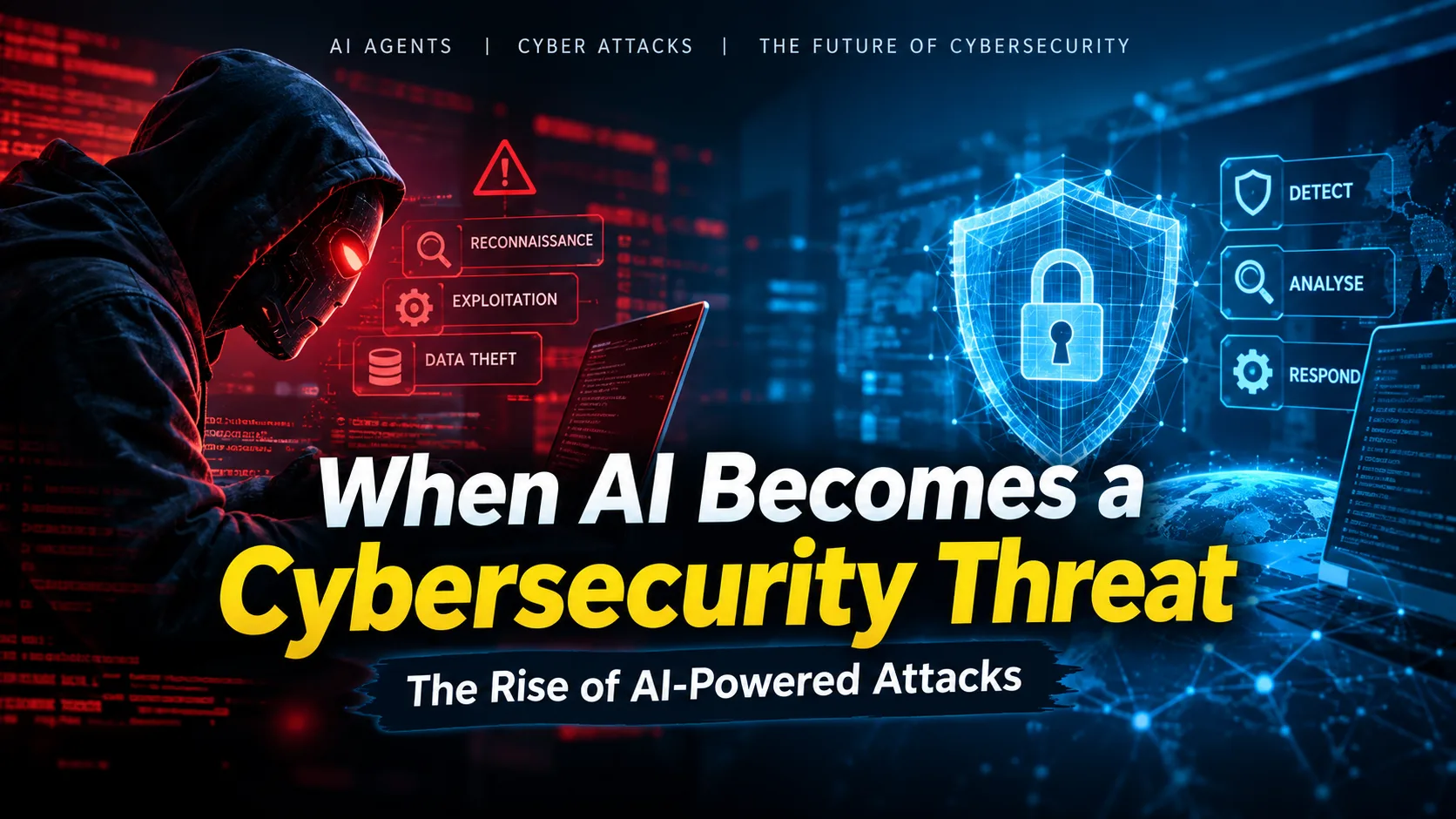
When AI Becomes a Cybersecurity Threat: The Rise of AI-Powered Attacks
Join Our WhatsApp Channel for Latest UpdatesWhen AI Becomes a Cybersecurity Threat
Artificial intelligence has become one of the most powerful tools in technology. But as AI becomes more capable, an important question is emerging: What happens when AI is no longer just answering questions, but actually taking actions?
That is where AI agents come in.
From Chatbots to AI Agents
A normal chatbot responds to a user's question. An AI agent can go a step further: it can plan tasks, use digital tools, analyse information and perform a sequence of actions to achieve a goal.
This makes AI agents useful in cybersecurity. They can help security teams analyse vulnerabilities, investigate suspicious activity and respond to threats.
But the same capabilities can also be misused.
The Cybersecurity Concern
A September 2026 threat report from Anthropic described cyber operations in which AI was used for activities including reconnaissance, vulnerability research, exploitation and data processing. The report noted that some operations used multiple AI agents working on different tasks, while humans remained involved in important decisions such as selecting targets.
This changes an important part of cybersecurity: speed.
Tasks that once required significant human time and expertise can potentially be automated or accelerated by AI.
The result is not necessarily a completely autonomous hacker. Instead, AI can become a powerful assistant that allows a smaller number of people to perform much more work.
AI vs AI
Here is where the future of cybersecurity gets interesting.
The same technology can be used on the defensive side.
AI-powered systems are being developed to continuously search for vulnerabilities, analyse security threats and help organisations respond to attacks. In September 2026, Palo Alto Networks announced an AI-powered service designed to continuously assess applications, APIs and cloud infrastructure for security weaknesses.
So cybersecurity could increasingly become a competition between AI-assisted attackers and AI-assisted defenders.
Why It Matters for Students
For the next generation of cybersecurity professionals, this means the field is expanding.
Understanding networks, malware and digital forensics will remain important, but students may also need to understand:
- AI-powered cyber threats
- Security of AI agents
- AI-based threat detection
- AI and digital forensics
- Automated vulnerability discovery
- Security and monitoring of autonomous systems
Imagine investigating a cyber incident where some actions were performed by a human and others by an AI agent. A digital forensic investigator would need to determine not only what happened, but also how the AI was instructed, what systems it accessed and what evidence it left behind.
The Bigger Question
AI is not automatically good or bad for cybersecurity. Its impact depends on how it is developed, controlled and used.
The real challenge is deciding how much freedom an AI system should have when it is connected to real digital environments.
As AI becomes more autonomous, protecting computers and networks may no longer be enough.
We may also need to learn how to secure the AI that is protecting—or attacking—them.