World Ozone Day 2026: Theme, History, Importance & Ozone Protection
Join Our WhatsApp Channel for Latest UpdatesWorld Ozone Day 2026: History, Importance, Theme & Why Ozone Protection Matters
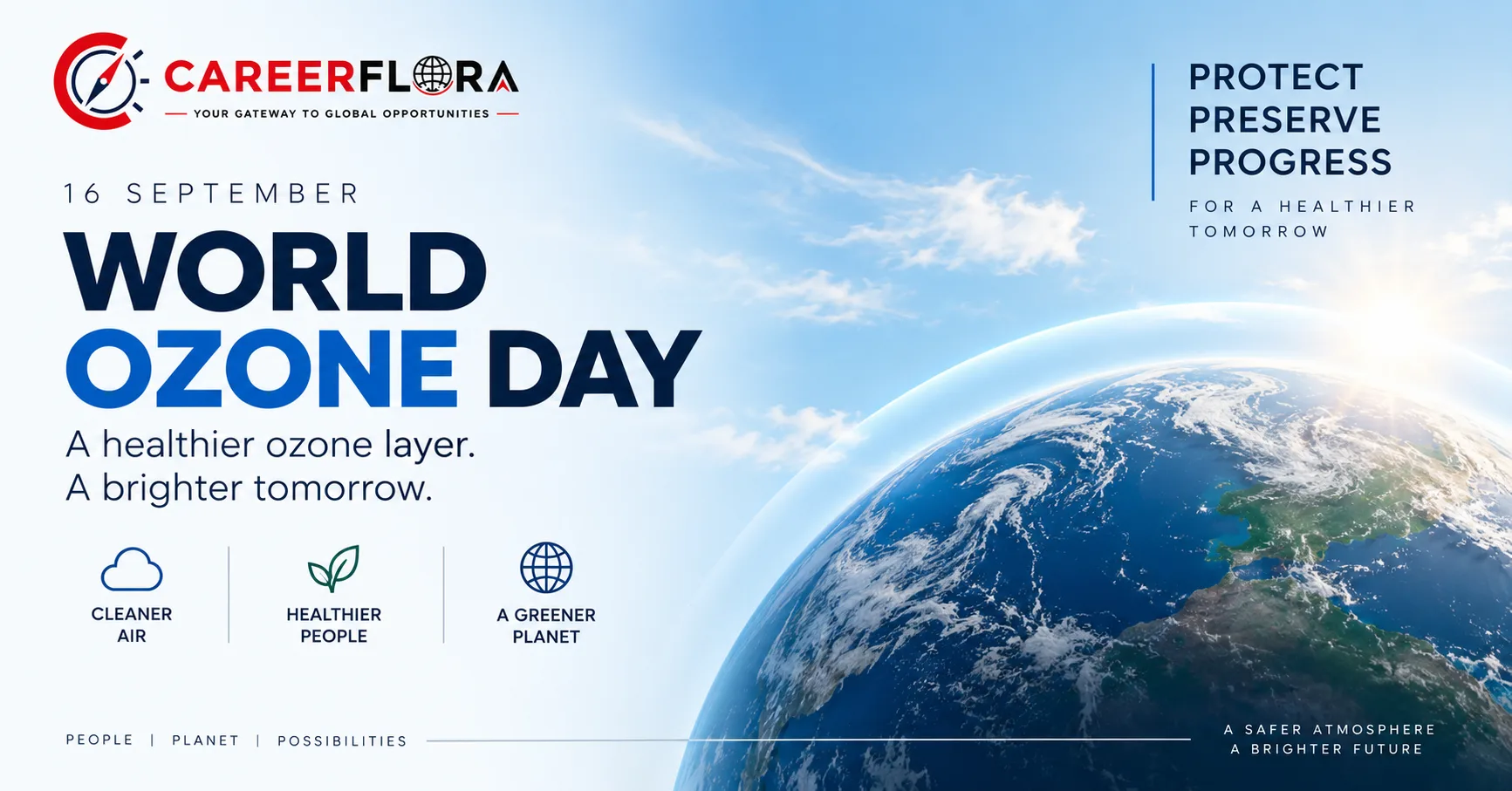
World Ozone Day, officially known as the International Day for the Preservation of the Ozone Layer, is observed every year on 16 September. The day highlights the importance of the ozone layer and global efforts to protect it from harmful ozone-depleting substances.
World Ozone Day 2026 is especially significant because it marks 10 years of the Kigali Amendment to the Montreal Protocol. The 2026 theme is “Global action for a cooler planet”, focusing on sustainable cooling, climate action and continued protection of the ozone layer.
What Is World Ozone Day?
The United Nations observes 16 September as the International Day for the Preservation of the Ozone Layer.
The date commemorates the signing of the Montreal Protocol on Substances that Deplete the Ozone Layer on 16 September 1987. The United Nations General Assembly officially proclaimed 16 September as the international observance in 1994.
The day reminds governments, industries and individuals about the importance of protecting the Earth's ozone layer and continuing international environmental cooperation.
World Ozone Day 2026 Theme
“Global action for a cooler planet”
The official 2026 theme is:
Global action for a cooler planet
The 2026 campaign also celebrates 10 years of sustainable cooling under the Kigali Amendment to the Montreal Protocol.
The theme connects ozone protection with another major environmental challenge: the need for efficient and sustainable cooling as global temperatures rise.
The Kigali Amendment focuses on reducing hydrofluorocarbons (HFCs), powerful greenhouse gases widely associated with cooling technologies. It encourages countries and industries to move toward more sustainable and energy-efficient cooling solutions.
Why Is the Ozone Layer Important?
The ozone layer is a region of the atmosphere that acts as a protective shield by absorbing much of the Sun's harmful ultraviolet (UV) radiation.
Without sufficient protection from UV radiation, humans, animals, plants and ecosystems can face serious risks. Excessive UV exposure can contribute to skin cancer, eye diseases and other health problems.
This makes ozone protection important not only for environmental sustainability but also for human health and the wellbeing of ecosystems
.
What Damages the Ozone Layer?
Several human-made chemicals have contributed to ozone depletion. These include substances such as:
- Chlorofluorocarbons (CFCs)
- Halons
- Carbon tetrachloride
- Methyl chloroform
- Methyl bromide
- Hydrochlorofluorocarbons (HCFCs)
Many ozone-depleting substances were historically used in refrigeration, air-conditioning, aerosol products and other industrial applications.
International agreements have helped countries reduce and phase out these substances.
Montreal Protocol and Ozone Protection
The Montreal Protocol is one of the most important international environmental agreements.
Adopted in 1987, it established measures to control and phase out the production and consumption of substances that damage the ozone layer. The agreement has been implemented globally and has played a major role in reducing ozone-depleting substances.
The Montreal Protocol demonstrates how science, international cooperation, policy and technological innovation can work together to address a global environmental problem.
What Is the Kigali Amendment?
The Kigali Amendment was adopted in 2016 as an amendment to the Montreal Protocol.
It introduced a global phase-down of HFCs. While HFCs do not directly deplete the ozone layer in the same way as CFCs, many HFCs are powerful greenhouse gases.
The amendment therefore connects ozone protection with climate action and sustainable cooling.
In 2026, the world marks the 10th anniversary of the Kigali Amendment, making this year's World Ozone Day particularly important.
World Ozone Day 2026 and Sustainable Cooling
Cooling has become increasingly important as temperatures rise and extreme heat becomes more common.
However, cooling systems can consume significant amounts of energy and may use refrigerants with environmental impacts.
The 2026 campaign therefore encourages a transition toward efficient, sustainable cooling technologies while continuing to reduce harmful refrigerants and greenhouse gases.
According to the United Nations, fully implementing the Kigali Amendment could avoid up to 0.5°C of global warming by the end of the century, with additional benefits possible when combined with energy-efficient cooling.
How Can We Help Protect the Ozone Layer?
Individuals can contribute by making environmentally responsible choices in everyday life.
Some useful steps include:
- Use energy-efficient cooling appliances.
- Maintain air conditioners and refrigerators properly.
- Choose environmentally friendly refrigerants where appropriate.
- Avoid unnecessary energy consumption.
- Support sustainable and climate-friendly technologies.
- Spread awareness about ozone protection.
- Follow environmental guidelines for disposal of old cooling equipment.
Individual actions are important, but large-scale progress also depends on government policies, industry innovation and international cooperation.
Why World Ozone Day Matters for Students
World Ozone Day is also an opportunity for students to understand the connection between science, technology, climate change and international policy.
Students can explore topics such as:
- Climate change
- Environmental science
- Sustainable technology
- Renewable energy
- Green engineering
- Refrigeration and cooling technologies
- Environmental policy
- Sustainable development
For students interested in science, engineering and sustainability, ozone protection provides an excellent example of how scientific research can lead to international action.
Conclusion
World Ozone Day 2026 is more than an environmental awareness day. It represents decades of international cooperation to protect the Earth's ozone layer and highlights the growing importance of sustainable cooling.
With the theme “Global action for a cooler planet,” the 2026 campaign emphasizes that protecting the ozone layer and addressing climate change can go hand in hand.
The story of the Montreal Protocol and Kigali Amendment shows that when countries, scientists, industries and communities work together, meaningful environmental progress is possible.
Happy World Ozone Day 2026
Let us continue working toward a healthier atmosphere, sustainable cooling and a cooler, safer planet for future generations.
CareerFlora — Your Gateway to Global Opportunities