World Calligraphy Day 2026: History, Meaning & How to Celebrate
Join Our WhatsApp Channel for Latest UpdatesWorld Calligraphy Day 2026: Celebrating the Art of Beautiful Handwriting
What the Day Is About
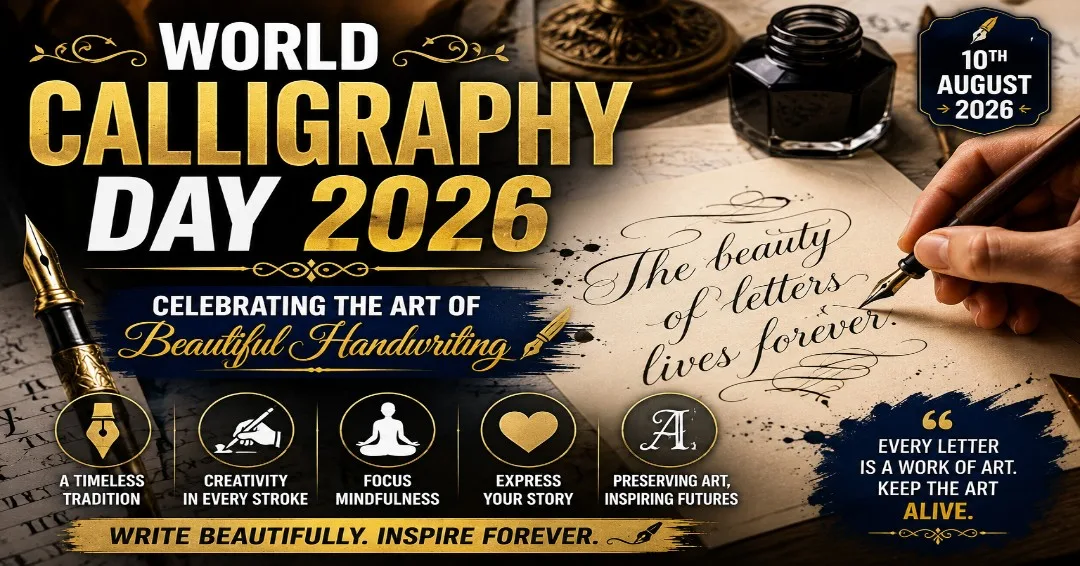
World Calligraphy Day is observed every year on the second Wednesday of August, landing on August 12 in 2026. The day is dedicated to the art of beautiful, expressive handwriting — celebrating calligraphers, hand-lettering enthusiasts, and anyone who finds meaning in the deliberate, artistic formation of words on a page.
The observance was founded in 2017 by the Manuscript Pen Company, in collaboration with the Pen Museum in Birmingham, United Kingdom, with the goal of bringing calligraphy artists and enthusiasts together to celebrate and promote the craft.
A Craft With Ancient Roots
Calligraphy is one of humanity's oldest art forms, with its origins tracing back roughly 2,000 years to around 200 BC in China. But its story doesn't belong to any single culture — artistic, expressive writing developed independently across many regions, each shaping its own distinct tradition. Over the centuries, the art form has taken shape through Western European, Chinese, Japanese, and Islamic calligraphic traditions, among others, each with its own tools, techniques, and aesthetic philosophy.
The materials calligraphers have used have shifted dramatically across history too. Writing surfaces have included animal skins, tree bark, and papyrus, while ink itself has a documented history stretching back to the 27th century BC in China. The very first brushes are believed to have originated in Egypt, where scribes burned papyrus roots and mixed the ash with gum from acacia or cherry trees to create ink — an early example of how deeply intertwined calligraphy has always been with material innovation.
Calligraphy also holds deep significance in religious and manuscript traditions. Early biblical texts, for instance, were rendered in Biblical Hebrew calligraphy, and the art form has a particularly rich history within Christian monastic tradition — Irish and Scottish monks famously created illuminated manuscripts by hand, turning scripture into visual art. Several Christian saints are specifically remembered for their work as calligraphers, a reminder of how central the craft once was to the preservation and transmission of religious and literary texts.
By the Middle Ages, calligraphy had reached the status of one of the era's most respected art forms. The word "calligraphy" itself comes from the Greek words kallos, meaning beauty, and graphein, meaning to write — and it wasn't formally introduced into the English language until 1613.
Why the Day Matters Now
In an age dominated by keyboards, touchscreens, and autocorrect, World Calligraphy Day serves as a deliberate pause — a reminder that handwriting isn't just a functional skill, but a form of individual expression that's steadily disappearing from daily life. Fewer students are being taught formal handwriting in schools today, as digital tools have become the default for nearly all writing. Advocates of the day argue that losing handwriting as a widely practiced skill would mean losing something more than penmanship — a tactile, personal connection to language that typing simply doesn't replicate.
That's part of why the day resonates beyond dedicated calligraphy enthusiasts. Even for people who've never picked up a calligraphy pen, the day is an invitation to slow down and reconnect with the physical act of writing, something increasingly rare in daily routines built around screens.
How People Celebrate
World Calligraphy Day tends to bring out a mix of creative and commercial activity each year:
- Workshops and open houses hosted by local art studios, introducing beginners to pen holds, nib types, and basic lettering strokes.
- Online courses and tutorials through platforms like Skillshare and Domestika, which often feature calligraphy-specific content or discounts around the observance.
- Retail promotions from art supply companies — Manuscript Pen Company, the day's founder, along with retailers like Paper Source, Blick Art Materials, and JetPens, typically run sales on fountain pens, inks, fine papers, and nibs.
- Exhibitions and online showcases, where practicing calligraphers share finished pieces, from traditional manuscript-style lettering to modern hand-lettered art.
- Personal practice, which is really at the heart of the day — many people simply set aside time to write something by hand with intention, whether that's a quote, a letter, or a page of practice strokes.
Getting Started With Calligraphy
If the day has you curious about trying calligraphy yourself, you don't need elaborate equipment to begin:
- Start with a basic calligraphy pen or brush pen. Beginner-friendly brush pens are widely available and far more forgiving than traditional dip pens and ink.
- Learn basic strokes before full letterforms. Most calligraphy styles are built from a small set of repeated basic strokes — mastering those first makes full letters much easier.
- Pick one script to focus on. Modern brush lettering, traditional Copperplate, and Gothic blackletter are all popular starting points, each with very different aesthetics and skill curves.
- Practice consistently, even briefly. Like any hand skill, calligraphy improves through repetition far more than through long, infrequent sessions.
- Look to tutorials and community spaces. Online communities and beginner tutorials can offer feedback and structure that's hard to get from practicing alone.
The Bottom Line
World Calligraphy Day, marked each year on the second Wednesday of August, is a celebration of one of the oldest and most enduring art forms in human history — one that spans continents, religious traditions, and thousands of years, yet faces a genuinely uncertain future in an increasingly digital world. Whether you're a lifelong calligrapher or someone who hasn't handwritten more than a grocery list in years, the day is really an invitation to pick up a pen, slow down, and rediscover the quiet artistry in the simple act of forming letters by hand.