
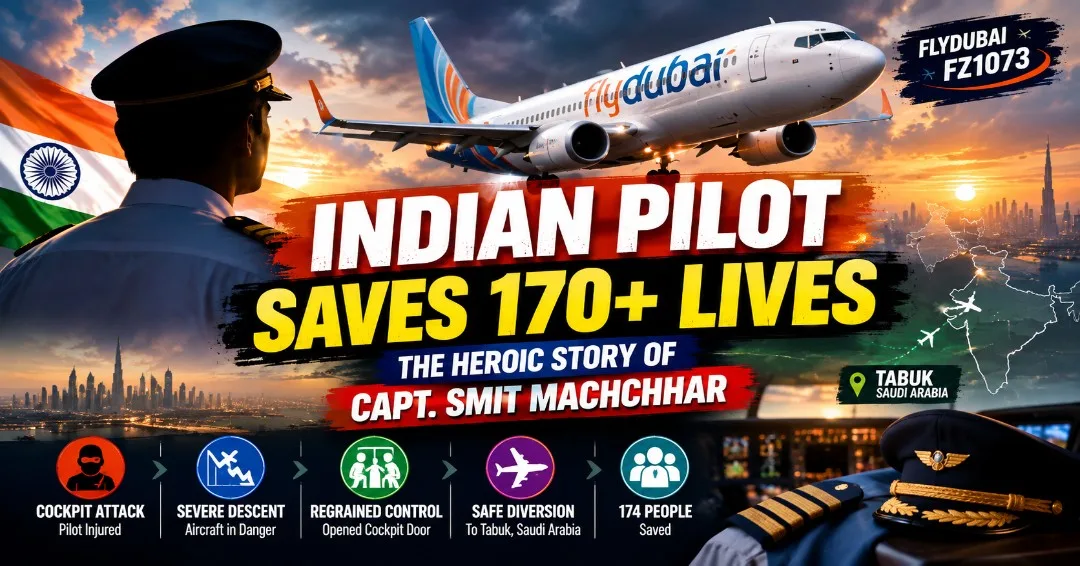
Indian Pilot Saves 170+ Lives: The Heroic Story of Captain Smit Machchhar
Join Our WhatsApp Channel for Latest Updates🚨BLOG OF THE DAY!
📌 Indian Pilot Saves 174 Lives | The Heroic Story of Captain Smit Machchhar
Captain Smit Machchhar, an Indian pilot from Mumbai, is being praised worldwide after his courageous actions during a serious cockpit emergency aboard flydubai Flight FZ1073 on September 30, 2026.
📋 Key Highlights:
🔹 Flight: flydubai FZ1073, Dubai to Tel Aviv
🔹 Passengers: 174 people, including 27 children
🔹 Emergency: The co-pilot allegedly attacked Captain Machchhar inside the cockpit and attempted to crash the aircraft.
🔹 Captain's Response: Despite sustaining serious injuries, Machchhar opened the cockpit door, allowing crew and passengers to intervene.
🔹 Safe Landing: The aircraft was diverted and safely landed in Tabuk, Saudi Arabia, with assistance from two off-duty pilots onboard.
🔹 Experience: Machchhar has nearly 9,750 flying hours and previously worked with SpiceJet before joining flydubai in 2022.
Prime Minister Narendra Modi praised Captain Machchhar's courage and presence of mind, while international leaders also recognised his actions.
🌐 Read the Complete Story: https://www.careerflora.com
#CareerFlora #SmitMachchhar #IndianPilot #Flydubai #Aviation #Hero #BreakingNews #IndiaNews
The Descent Into Nightmare: Flight FZ1073
The flight departed Dubai International Airport under routine conditions, operating a scheduled passenger service to Tel Aviv. Flying aboard a modern Boeing 737 MAX 8, the aircraft climbed smoothly to its cruising altitude, carrying roughly 174 passengers and crew members. For the first two hours, the journey was entirely unremarkable. Families rested, cabin crew completed meal services, and passengers settled in for what was expected to be an uneventful arrival.
Deep within the cockpit, however, the dynamic suddenly turned catastrophic. Without warning, the co-pilot launched a frenzied physical assault on Captain Machchhar. Armed with an improvised bladed instrument, the attacker struck the captain repeatedly across the head, neck, and hands.
The attacker’s objective became instantly and terrifyingly clear: he was attempting to force the airliner into a terminal dive.
Disengaging the autopilot, the assailant pushed the flight control column hard forward. The modern jet pitched down aggressively. In a matter of seconds, the aircraft began tumbling out of the sky, plunging more than 14,000 feet in under 30 seconds. Inside the passenger cabin, drinks flew toward the ceiling, oxygen masks dropped, and unrestrained items violently struck overhead bins as negative G-forces took hold. Absolute panic erupted among the passengers as the ground rushed up through the windows.
Blood, G-Forces, and a Split-Second Decision
Inside the cockpit, Captain Machchhar was losing blood rapidly. Severe lacerations to his hands and forehead blurred his vision, and the physical force of the dive pinned him against his harness. In high-altitude emergency training, pilots are taught that spatial disorientation and rapid decompression are deadly hurdles, but nothing prepares an aviator for a lethal struggle against their seatmate.
Captain Machchhar recognized a brutal reality: confined within the narrow cockpit, wounded and fighting off an armed adversary, he could not overpower the assailant and simultaneously pull back on the yoke alone. If the cockpit remained sealed, all 174 souls on board would perish in the desert below within two minutes.
Under international post-9/11 aviation regulations, flight deck doors are armored, blast-proof, and electronically deadbolted to prevent unauthorized entry from the cabin. Ironically, the very security mechanism built to protect flight crews from outside hijackers now trapped Captain Machchhar with a rogue inside.
Fighting through intense physical agony and dizziness from blood loss, Machchhar used his body to shield the primary flight console with one arm while reaching frantically for the emergency door release with the other. He overrode the electronic deadbolt and threw the reinforced door open into the forward galley, shouting for immediate help.
The Breached Door and the Battle in the Galley
The sound of the cockpit door unlatching changed the fate of Flight FZ1073. Flight attendants stationed near the forward galley saw the horrifying sight of their captain covered in blood, locked in combat at the controls.
Without hesitation, cabin crew shouted for assistance. Demonstrating remarkable instinct, several passengers surged down the aisle against the violent turbulence of the plunge. Among the first to reach the flight deck were an Israeli plumber, a dentist, and two off-duty commercial aviators traveling as passengers.
What followed was a desperate melee in the cramped entryway of the cockpit:
- Restraining the Attacker: Passengers and crew tackled the rogue co-pilot, wrestling the weapon from his grip. Using heavy-duty cabin zip ties, emergency restraint belts, and audio headphone cables, they pinned the assailant to the cabin floor and neutralized the threat.
- Arresting the Plunge: As the attacker was dragged clear of the control pedestal, an off-duty pilot leaped into the flight deck. Working in tandem with the bleeding Captain Machchhar, they seized the control column and pulled back with immense force.
- Leveling Off: The aircraft groaned under immense structural aerodynamic load as the nose slowly pitched up, leveling out mere thousands of feet above the rugged terrain below.
The immediate crash had been averted, but the emergency was far from over.
Diverting to Tabuk: A Precision Emergency Landing
With the cockpit secured and the attacker incapacitated, the flight deck took inventory of a dire situation. Captain Machchhar was growing faint from rapid blood loss and shock. The cockpit instruments were smeared with blood, and the aircraft required immediate assessment after enduring extreme aerodynamic stress beyond normal operational envelopes.
Declaring a universal Mayday distress call, the relief crew contacted regional air traffic control. The nearest viable runway was at Prince Sultan bin Abdulaziz Airport in Tabuk, Saudi Arabia.
Displaying monumental composure, Captain Machchhar refused to leave the cockpit until the aircraft was stabilized. He assisted the relief aviators with vital approach checklists, radio frequencies, and system configurations. Saudi air traffic controllers cleared all regional airspace, giving Flight FZ1073 a straight-in emergency approach to Tabuk.
Emergency medical teams and fire rescue vehicles lined the runway as the Boeing 737 MAX touched down safely. The evacuation was swift, orderly, and calm. Paramedics immediately boarded the aircraft, rushing Captain Machchhar directly to a specialized military trauma hospital in Tabuk, while security officials took the rogue co-pilot into custody.
Global Acclaim and the Lessons for Modern Aviation
News of the averted disaster sent shockwaves through international diplomatic and aviation corridors. World leaders publicly commended the Mumbai-born captain for his superhuman bravery.
Indian Prime Minister Narendra Modi praised Captain Machchhar’s extraordinary composure under fire, stating that his valor had made the entire nation proud. Israeli Prime Minister Benjamin Netanyahu issued a formal diplomatic tribute, expressing deep gratitude to the Indian captain on behalf of the dozens of Israeli citizens whose lives were spared thanks to his actions.
Beyond the headlines, international civil aviation bodies—including the ICAO and the FAA—are now examining the broader structural questions raised by Flight FZ1073:
- The Single-Point Vulnerability: Reinforced cockpit doors successfully closed the skies to external hijackers, but they inadvertently created an impenetrable fortress when a threat originates from within the flight crew itself.
- Mental Health and Screening: The incident has renewed urgent calls for rigorous, continuous behavioral evaluations and psychological monitoring for commercial flight crews operating high-density routes.
- The "Rule of Two": Industry regulators are re-evaluating mandatory cabin crew cockpit occupancy protocols whenever one pilot leaves or when abnormal behavior is detected.
The Indomitable Spirit of an Aviator
Aviation is often defined by mechanical engineering, automated computer systems, and sophisticated navigation algorithms. Yet, when technology and systems are pushed to the brink of failure, human character remains the final, decisive safety layer.
Captain Smit Machchhar did not panic when confronted with a sudden, vicious betrayal at cruising altitude. He did not freeze as his blood pooled on the instrument panels, nor did he surrender to the terrifying pull of a 14,000-foot death dive. He evaluated his options, made the selfless decision to break cockpit protocol, and opened the door to survival.
Today, 174 people are alive because an Indian pilot from Mumbai stood his ground at 35,000 feet. His name is forever etched among the bravest figures in aviation history.