DeepSeek Harness GitHub Project: Everything Is a Plugin
Join Our WhatsApp Channel for Latest UpdatesDeepSeek Harness GitHub Project: What Is It?
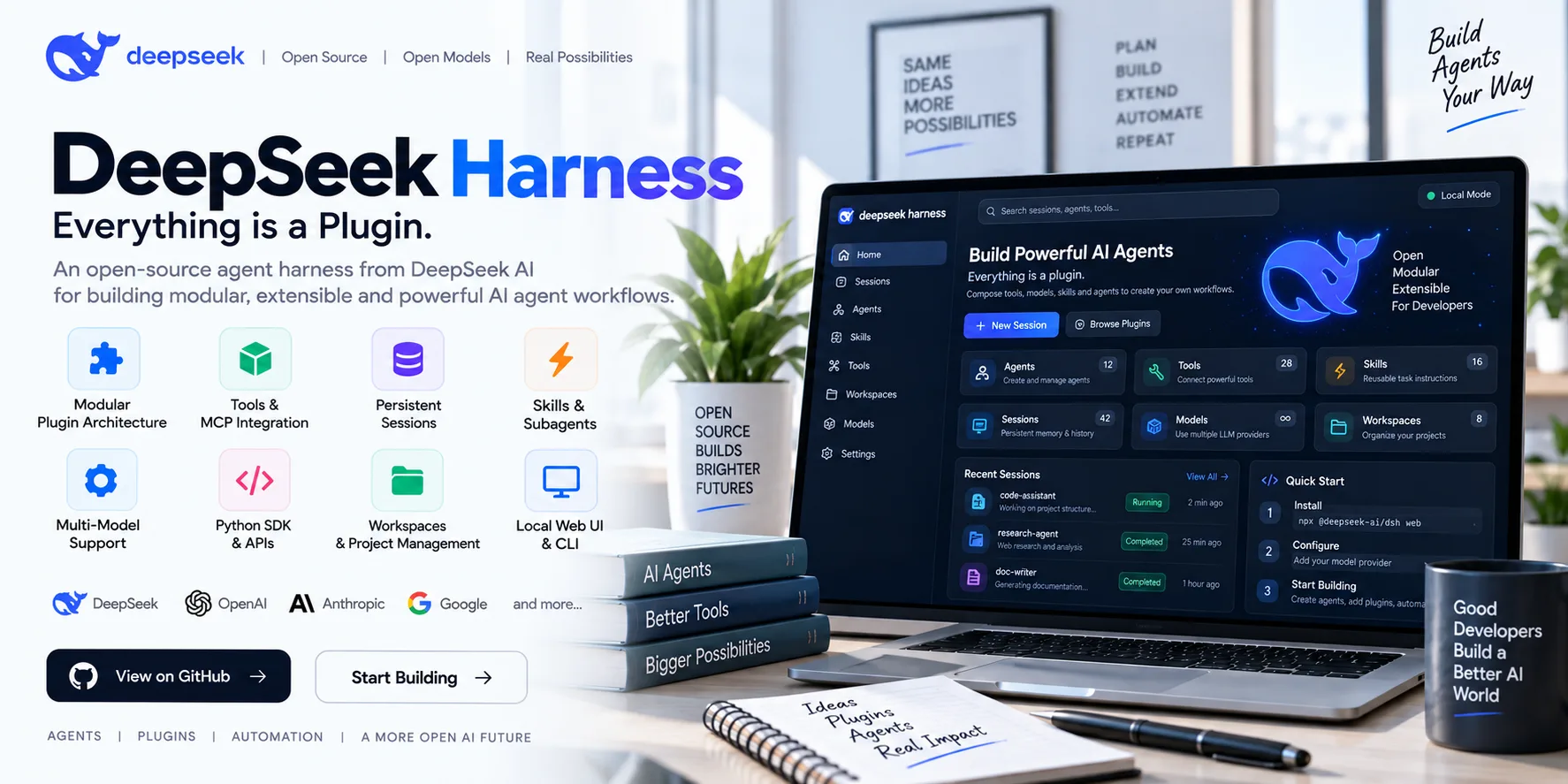
DeepSeek Harness is an open-source agent harness developed by DeepSeek AI. Its central architectural idea is simple:
Everything is a plugin.
The project is powered by Cordis, a framework designed around composable services and extensions. Rather than building an AI agent as one large application, DeepSeek Harness separates capabilities into modular components that can be replaced, extended or composed.
The repository is currently in developer preview and is being iterated rapidly, with the maintainers explicitly warning that compatibility-breaking changes can occur.
What Is an Agent Harness?
An AI agent needs more than an LLM.
A practical agent typically requires:
- Sessions
- Prompt management
- Model providers
- Tools
- File and shell access
- Memory or persistent state
- Skills
- Subagents
- Scheduling
- User feedback
- APIs
- Interfaces
An agent harness provides the infrastructure connecting these pieces.
DeepSeek Harness approaches this through a modular plugin architecture rather than putting every capability directly into the core agent.
Everything Is a Plugin
The defining idea behind DeepSeek Harness is its plugin-oriented architecture.
The repository organizes functionality into capability families such as:
- Core agent loop
- Sessions
- Tools
- LLM providers
- Subprocess execution
- Skills
- Scheduling
- Feedback
- Identity
- Workspaces
- APIs
- Subagents
The package architecture separates service definitions from implementations, allowing components to evolve independently.
This means developers can work with a specific part of the system without having to rebuild the entire agent.
Core Architecture
The packages/core area contains several important pieces of the agent spine.
These include:
Sessions
The session subsystem maintains the agent's history as an append-only event log.
System Prompts
System-prompt components assemble the instructions and context supplied to the model.
Tools
The tool subsystem provides the registry and guarded execution pipeline through which agent tools are dispatched.
Agent
The agent package provides the main Agent abstraction and its registry/events.
Agent Loop
The agent-loop package provides the default driver responsible for creating agents and running their turn/step lifecycle.
LLM Provider Architecture
DeepSeek Harness also separates the LLM capability family from the rest of the system.
This allows model-provider adapters to be handled independently from the core agent infrastructure. The package structure identifies llm/ as the LLM capability family containing the abstract service and provider adapters.
This is useful for an agent framework because the model layer can change without forcing every other component to be rewritten.
Skills System
DeepSeek Harness includes a dedicated Skills subsystem.
Skills are reusable instructions that can be discovered and loaded when required.
The current architecture includes:
- Skill registry
- Filesystem-based skill discovery
- Skill catalogs
- Model-facing skill loader
- Office-related workflows
- Direct skill invocation
The documentation describes skills as reusable task instructions that can be loaded only when needed.
This creates a workflow where the model doesn't necessarily need every instruction loaded into its context from the beginning.
Subagents
DeepSeek Harness also provides infrastructure for running additional agents.
This makes it possible to construct workflows where one agent can delegate work to another agent or where multiple agent sessions can operate independently.
The architecture includes dedicated packages for agent-to-agent and ACP-related workflows.
A simplified workflow can look like:
Main Agent
↓
Task Delegation
↓
Subagent
↓
Tool Execution
↓
Result
↓
Main Agent
This architecture is particularly relevant to multi-agent AI applications.
Agent Client Protocol
One of the more interesting components is its Agent Client Protocol (ACP) support.
The ACP package allows programs and automation systems to run persistent DeepSeek Harness agents over JSON-RPC via standard input/output.
Clients can:
- Create sessions
- List sessions
- Resume sessions
- Close sessions
- Attach MCP servers
- Select models
- Send text prompts
- Send image prompts
- Receive updates
- Respond to permission prompts
- Cancel work
The ACP server is designed specifically for programmatic automation and does not require a human to remain in the loop.
Python SDK
DeepSeek Harness also includes a Python SDK for driving the harness as a subprocess.
The SDK communicates with the bundled runtime through newline-delimited JSON-RPC over standard I/O.
Installation currently uses:
python -m pip install deepseek-harness-sdk
A basic Python workflow can then create a DeepSeekHarness instance with an explicitly selected Harness home, working directory, provider and model.
This makes the harness usable from Python-based automation and applications rather than only through its own UI.
Persistent Workspaces
DeepSeek Harness also has a workspace subsystem.
The workspace family allows applications to maintain an ordered collection of named projects and group sessions by directory.
Users can browse projects and sessions, hide sessions from project grouping and remove project records without deleting the underlying folder or session history.
For developers working across multiple repositories, this provides a structured project/session layer around agent activity.
Web UI
DeepSeek Harness provides a local Web UI.
The quickest documented method is:
npx @deepseek-ai/dsh web
The local server runs at:
http://127.0.0.1:3080
By default, the local launch can open the interface in the system browser. The --no-open option can be used when the browser should not be opened automatically.
Running from Source
Developers who want to work directly with the repository can clone it and build it locally:
git clone https://github.com/deepseek-ai/deepseek-harness.git

cd deepseek-harness

pnpm install

pnpm run build

pnpm dsh web
The repository documentation notes that pnpm run build prepares the required artifacts, while pnpm dsh web runs the Web UI using those built artifacts.
DeepSeek Harness and MCP
The project also has infrastructure for connecting tools and external capabilities.
Its ACP implementation, for example, allows clients to attach standard MCP servers to persistent agent sessions.
This makes the architecture relevant to developers building agent systems around:
LLM + MCP + Tools + Skills + Subagents + Persistent Sessions
Example Agent Architecture
A simplified DeepSeek Harness workflow can be understood as:
                AI Model
                   |
             Agent Loop
                   |
        +----------+----------+
        |          |          |
      Tools      Skills    Subagents
        |          |          |
     MCP /      Reusable    Other
     APIs       Tasks       Agents
        |          |          |
        +----------+----------+
                   |
              Session Log
                   |
             Workspace / UI
The important part is that these components are not treated as one inseparable block. They are organized into modular capability families.
Why the Plugin Architecture Matters
Traditional AI applications often grow into large codebases where model logic, tools, UI, storage and business logic become tightly connected.
DeepSeek Harness takes another approach.
Its architecture attempts to keep these capabilities separate:
Agent → Capability → Service → Provider
That makes it possible to replace or extend specific parts of the system without necessarily modifying the complete agent.
The repository documentation explicitly describes extension plugins as depending on Service Definitions rather than concrete providers, reinforcing this separation.
Who Can Use DeepSeek Harness?
The project can be useful for:
- AI agent developers
- AI coding-tool developers
- Full-stack developers
- Python developers
- TypeScript developers
- Researchers experimenting with agent architectures
- Developers building multi-agent systems
- Developers working with MCP
- Developers building custom AI runtimes
For students learning AI engineering, it can also serve as a practical example of how a large agent system can be broken into modular services.
What Can Developers Learn From It?
DeepSeek Harness is useful to study if you're interested in agent infrastructure rather than only prompting.
Important concepts visible in the project include:
- Agent loops
- Plugin architecture
- Service-oriented design
- LLM provider abstraction
- Tool registries
- Session event logs
- Skills
- Subagents
- MCP integration
- JSON-RPC
- Persistent workspaces
- Python SDKs
- Web interfaces
These concepts are increasingly relevant when building production-oriented AI applications.
Project Status
DeepSeek Harness is currently a developer preview.
The official repository states that development is moving quickly and that compatibility-breaking changes should be expected. The project also directs users to review its safety notice before running it.
So developers exploring the repository should treat its APIs and architecture as actively evolving rather than assuming long-term API stability.
License
DeepSeek Harness is released under the MIT License. Third-party dependencies and their respective licenses are documented separately in the repository.
Official Resources
GitHub Repository: https://github.com/deepseek-ai/deepseek-harness
Documentation: https://deepseek-harness.github.io/deepseek-harness/
DeepSeek Harness: https://deepseek.com/harness