How Digital Payments Work in India
Join Our WhatsApp Channel for Latest UpdatesHow Digital Payments Work in India: A Complete Guide
A decade ago, most transactions in India involved cash changing hands. Today, a street vendor selling tea can accept a payment in under two seconds by showing a small paper QR code. That shift didn't happen by accident — it's the result of a deliberate, government-backed push to build shared digital infrastructure that any bank, app, or business could plug into.
Here's how the system actually works, piece by piece.
The Foundation: A Shared Public Infrastructure
Most countries left digital payments to private companies to sort out on their own. India took a different approach. The Reserve Bank of India (RBI) and the National Payments Corporation of India (NPCI) — a non-profit set up by RBI and major banks — built shared "rails" that every bank and payment app could use for free or near-free. This is often called India's "Digital Public Infrastructure" (DPI) model, and it's the reason payments here are so cheap, fast, and interoperable, regardless of which app or bank you use.
Three pieces make up the backbone:
- Aadhaar – a biometric-linked ID number for nearly every resident, used to verify identity and open bank accounts remotely.
- Bank accounts for all – the Jan Dhan Yojana scheme opened hundreds of millions of no-frills bank accounts for people who'd never had one before.
- UPI (Unified Payments Interface) – the real-time payment rail that sits on top and moves the money.
Together, these are sometimes nicknamed the "India Stack." UPI is the part people actually interact with every day, so it's worth understanding in detail.
UPI: The Engine Behind Everyday Payments
UPI, launched by NPCI in 2016, lets you send money instantly between any two bank accounts using nothing but a phone number, a QR code, or a short ID like name@bank. There's no need to share account numbers or IFSC codes.
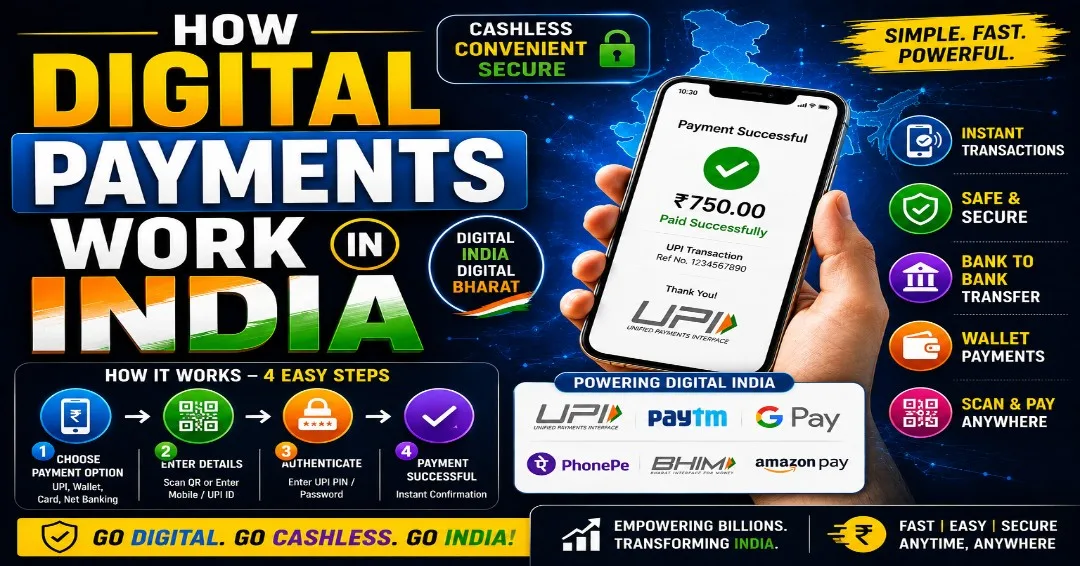
How a UPI payment actually flows:
- You open a UPI app (PhonePe, Google Pay, Paytm, your bank's own app, etc.) and scan a QR code or enter a UPI ID.
- You confirm the amount and authenticate with your UPI PIN (a 4–6 digit code you set when linking your bank account).
- Your app sends the request to NPCI's UPI switch, which instantly checks with your bank to confirm the money is available.
- NPCI's switch simultaneously contacts the recipient's bank to credit the funds.
- Both banks confirm back to NPCI, and the whole thing settles in a few seconds — 24/7, including weekends and holidays.
The important design detail: the app is just a front end. PhonePe, Google Pay, and your bank's app all ride the same NPCI rail. A payment from a PhonePe user to a Google Pay user works exactly the same as one within the same app, because both are just talking to the same underlying system. This interoperability is what killed the "walled garden" model you see with wallets in other countries.
The scale this has reached is genuinely unusual by world standards. In May 2026, UPI processed <cite index="2-1">23.2 billion transactions worth Rs 29.9 trillion, the highest monthly throughput on record, with a daily average of 737.79 million transactions</cite>. <cite index="2-2">India now accounts for roughly 49% of global real-time payment transaction volume, more than three times Brazil's Pix share</cite>, and the <cite index="5-2">International Monetary Fund has formally recognized UPI as the world's largest real-time payment system by transaction volume</cite>.
For scale of growth: <cite index="5-1">annual UPI transaction volume grew from just 2 crore transactions in FY 2016-17 to over 24,162 crore transactions in FY 2025-26 — an almost 12,000-fold increase</cite>.
Beyond UPI: The Other Rails
UPI dominates day-to-day retail payments, but it isn't the only system running. A few others matter:
- IMPS (Immediate Payment Service) – an older instant transfer system using account number + IFSC code, still used for larger or scheduled transfers.
- NEFT / RTGS – batch and real-time settlement systems mainly used for larger bank-to-bank transfers, especially by businesses.
- RuPay – India's homegrown card network (an alternative to Visa/Mastercard), often bundled with UPI-linked credit lines now.
- Bharat Bill Pay System (BBPS) – a unified system for paying utility bills, subscriptions, and loan EMIs across any biller, through any bank or app.
- AePS (Aadhaar-enabled Payment System) – lets people withdraw cash or check balances using just a fingerprint and Aadhaar number, crucial in rural areas without smartphones.
- FASTag – automatic toll payments via RFID tags linked to a prepaid account.
Each solves a slightly different problem, but nearly all of them connect back to NPCI's infrastructure in some way.
Who Actually Handles Your Money
It helps to separate the players by role:
- NPCI – builds and operates the shared rails (UPI switch, RuPay, BBPS, FASTag). It doesn't hold your money.
- Banks – hold the actual accounts and money. Every UPI transaction ultimately debits and credits real bank accounts.
- Payment apps (PhonePe, Google Pay, Paytm, etc.) – the interface you use. They're called Third-Party Application Providers (TPAPs) and must partner with a bank to process transactions.
- RBI – the regulator overseeing the whole system, setting rules on security, data storage, and licensing.
This layered structure is why a payment app going down doesn't mean your money is at risk — your money never actually sits with the app.
Security: PINs, Not Passwords
Every UPI transaction requires a UPI PIN entered on your own device at the moment of payment — not a password stored on a server. Combined with device binding (your UPI app is tied to your specific phone and SIM), this makes remote takeover significantly harder than with card-based fraud. Most scams that do happen rely on tricking people into entering their PIN or approving a request themselves, rather than breaking the system technically — which is why "never share your UPI PIN, and never approve a payment request you didn't initiate" remains the standard advice.
Where It's Headed
A few trends are shaping the next phase:
- UPI going global – <cite index="6-2">the platform is now operational in more than eight countries including the UAE, Singapore, France, Mauritius, Sri Lanka, and Greece</cite>, letting Indian travelers and the diaspora pay abroad the same way they do at home.
- Credit on UPI – banks are increasingly letting people spend from a credit line, not just a savings account, over the same UPI rails.
- UPI Lite and feature-phone UPI – lightweight, low-data versions aimed at users without high-end smartphones or reliable connectivity.
A less lopsided app market – <cite index="2-1">an app-share reshuffle in May 2026 broke the long-standing PhonePe-Google Pay duopoly for the first time</cite>, as NPCI has pushed to onboard more competing apps.
The Bigger Picture
What makes India's system distinctive isn't any single piece of technology — QR codes and instant transfers exist elsewhere too. It's the decision to treat payments infrastructure like a public utility (similar to roads or the electricity grid) that any bank or company can build on top of, rather than letting a handful of private companies each build their own closed system. That choice is a big part of why a small shop owner and a large enterprise can use the exact same rail, for close to zero cost, with money moving in seconds.
💡 Why Choose CareerFlora?
Stay updated with the latest government jobs, admit cards, results, ETC, only on CareerFlora – Your Gateway To All Opportunities 🌱