How Instagram's Algorithm Works in 2026
Join Our WhatsApp Channel for Latest UpdatesHow Instagram's Algorithm Works in 2026
If you've ever posted something you were proud of and watched it disappear into silence — while a rushed, unedited video somehow took off — you've felt the confusion Instagram's algorithm creates for almost everyone who uses it. The good news: Instagram has been unusually transparent about how it actually works, mostly through Head of Instagram Adam Mosseri's own explainer videos. Here's what's actually going on behind the scenes.
There's No Single "Instagram Algorithm"
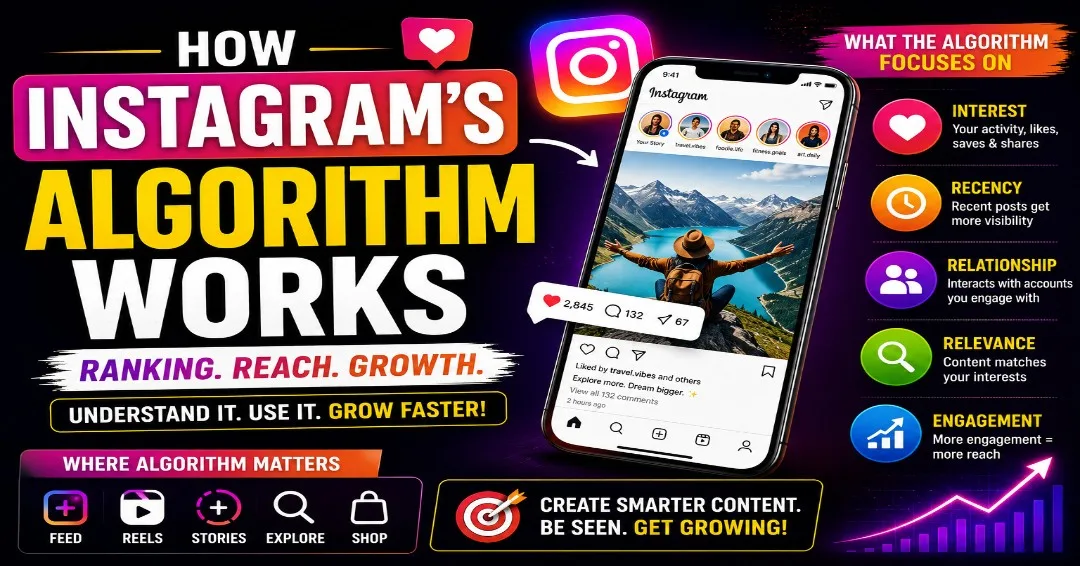
The first myth to clear up: Instagram doesn't run one master algorithm that scores everything. It runs several separate AI-powered ranking systems — one each for the main Feed, Stories, Explore, and Reels — because people use each of these spaces differently. As Mosseri has put it, people look for close friends in Stories, use Explore to find new creators, and go to Reels to be entertained. Trying to optimize for "the algorithm" as one thing misses how differently each of these systems actually behaves.
The Feed: Built Around Relationships
Your main Feed prioritizes people and accounts you already have a relationship with. The system pulls a pool of posts it thinks are relevant to you — from people you follow and from recommended accounts — then ranks that pool using a handful of signals, including:
- What you personally engage with — the posts you like, save, share, or comment on tell Instagram what actually resonates with you specifically.
- How the content performs overall — likes, comment speed, and shares from everyone else, not just you.
- Negative signals — how often people skip a post, scroll past quickly, or leave the app shortly after seeing it. These push content down just as strongly as positive signals push it up.
Instagram also deliberately avoids showing you several posts in a row from the same account, blending followed and recommended content so the Feed doesn't feel repetitive.
The practical takeaway: replying to comments and encouraging real back-and-forth genuinely matters here, since relationship strength is one of the more heavily weighted signals in this particular feed.
Explore: Built Around Curiosity, Not Connection
Explore works completely differently from the Feed. It's not based on who you follow at all — it's based purely on what you engage with. Every Explore page is essentially built from your own history of likes, saves, and watch time, which is why two accounts belonging to the same person can have wildly different Explore pages.
Here, "popularity signals" — how fast a post gains likes, saves, and comments — matter most. When a post gains traction quickly, Instagram treats that as a strong signal and tests it with progressively larger audiences.
Reels: Optimized for Watch Time and Discovery
Reels exist to entertain people who don't already follow you, which makes it the platform's strongest discovery engine — and also its most competitive space, since attention spans are short and content volume is enormous.
A new Reel typically gets tested with a small audience first. If it holds attention and earns strong engagement in that early test, Instagram expands its reach to larger, often unconnected audiences. This is also why Trial Reels — a feature that shows a Reel only to non-followers before deciding whether to share it more broadly — has become a popular way for creators to test content without risking their existing audience's feed.
What's Actually New in 2026
Two real shifts are changing how this all works:
1. Instagram is starting to understand content itself, not just how people react to it. Historically, ranking was almost entirely behavior-based: what you watched longer, liked, or shared. Instagram is now using more advanced AI to analyze what a Reel is actually about — its content and topic — rather than relying purely on engagement patterns. That's a meaningful shift from an algorithm that guesses what you want based on behavior, to one that can parse the substance of what's being shown.
2. Users can now directly steer their own Reels feed. With the "Your Algorithm" feature for Reels, people can explicitly tell Instagram which topics they want more or less of, instead of the system inferring it entirely from behavior. For creators, this means a well-defined content niche is becoming more valuable, not less — if someone tells Instagram they're interested in a specific topic, accounts covering that topic clearly and consistently are positioned to benefit directly.
3. Original, platform-native content is being pushed harder. Instagram has signaled it will increasingly reward content that feels made specifically for Instagram, rather than recycled from other platforms — favoring originality and creative pacing over recycled or repurposed clips.
What This Actually Means If You Post on Instagram
A few things follow directly from how these systems work:
- Stop thinking about "the algorithm" as one thing. A post that does well in Explore might do nothing in the Feed, and vice versa — they're optimizing for different outcomes entirely.
- Engagement quality matters more than nostalgia for old growth hacks. Tactics like the old "5-3-1 rule" (like five posts, comment on three, gain one follower) reflect a much simpler, earlier version of how ranking worked. Today's systems weigh watch time, negative signals, and now increasingly the actual substance of your content.
- Niche clarity is becoming a genuine advantage. With users now able to explicitly tell Instagram what they want to see more of, creators with a clear, consistent topic are easier for the system to match to the right audience.
- You can't "beat" the algorithm, but you can stop fighting it. Every explainer Instagram has put out points to the same underlying goal: showing people content they're likely to genuinely care about. The more clearly your content signals who it's for, the less guessing the system has to do — and the more often it gets shown to people who'll actually respond to it.
The algorithm isn't trying to bury you. It's trying to guess, as fast as possible, whether a person will stay, engage, or scroll past. Understanding that one goal — for each part of the app — explains almost everything else about how Instagram decides what to show.
💡 Why Choose CareerFlora?
Stay updated with the latest government jobs, admit cards, results, ETC, only on CareerFlora – Your Gateway To All Opportunities 🌱