
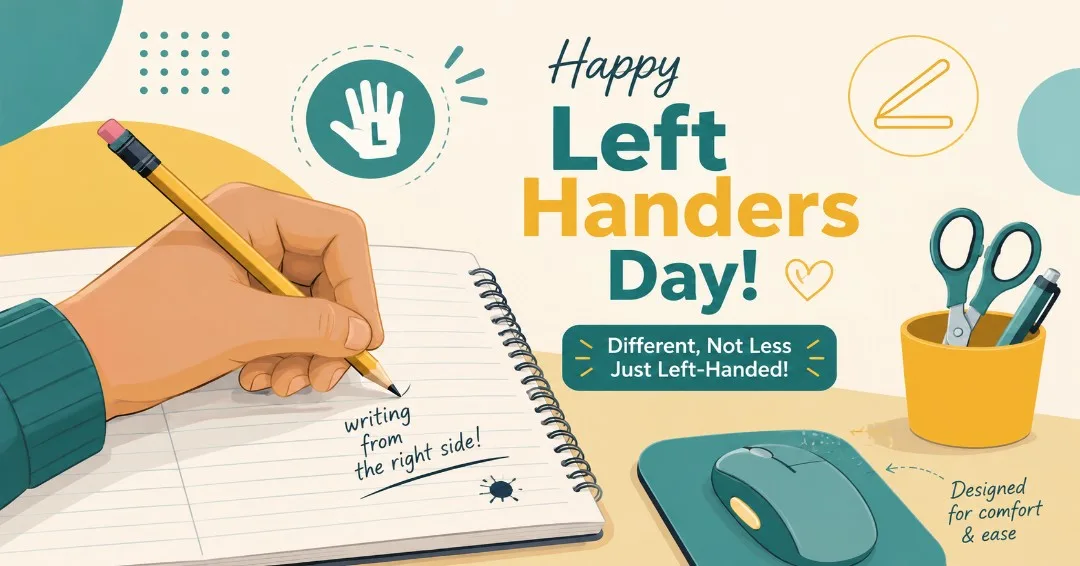
International Left-Handers Day 2026: Students, Teachers & Workplace Awareness
Join Our WhatsApp Channel for Latest UpdatesInternational Left-Handers Day 2026: Students, Teachers & Workplace Awareness
What the Day Is About
International Left-Handers Day is observed every year on August 13, and 2026 marks its 50th anniversary since Dean R. Campbell, founder of Lefthanders International, Inc., first observed the day in 1976. The Left-Handers Club later formalized it as an annual global observance in 1992, with a mission to raise awareness of the everyday advantages and disadvantages of being left-handed in a world largely built around right-handed use.
The numbers behind the day are notable on their own: roughly 7–10% of the world's population is left-handed, meaning nearly 1 in 10 people navigate a world where scissors, can openers, desks, sports equipment, and even everyday gadgets are typically designed with right-handed users in mind. Left-handedness is not a disability or a disorder — it's a natural variation in hand preference, influenced by a mix of genetics and development, and some people even fall into "mixed-handedness," using different hands for different tasks.
There's no single official theme for 2026, but schools, offices, and communities worldwide are encouraged to build activities around ideas like inclusion, accessibility, equal opportunity, and ergonomic design.
Interestingly, scientists still don't have a definitive answer for why some people develop a left-hand dominance. Genetics appears to play a role — a child is statistically more likely to be left-handed if one or both parents are lefties — but researchers haven't pinned down a single cause. What is well established is that the prevalence of left-handedness has stayed roughly constant across generations, even as social attitudes toward it have shifted considerably. In other words, society's acceptance of left-handedness has changed a great deal over the past century; the underlying biology hasn't.
Why It Still Matters
It's easy to assume handedness is a minor detail, but the day's origins point to something more serious. Historically, left-handed children were often forced to switch to their right hand, and in earlier centuries, left-handedness was sometimes viewed with suspicion or even associated with negative superstition. While that stigma has faded substantially, the physical world hasn't caught up nearly as quickly — most tools, furniture, and technology are still designed around right-handed defaults, which means left-handers often adapt quietly rather than get accommodated directly.
That's really the heart of what this day is pushing for: not sympathy, but practical redesign and awareness.
It's also worth noting that many left-handers become remarkably adept at working around a right-handed world — using right-handed scissors with a slightly altered grip, adapting to spiral notebooks, or learning tools "backwards" compared to how they were designed. That adaptability is often framed as a strength, even a hidden advantage in fields that reward flexible thinking. But the fact that so much of this adaptation is invisible and unacknowledged is precisely why a dedicated awareness day still has a role to play — it gives a moment to actually name what's usually just quietly absorbed.
For Students: What Left-Handed Learners Deal With
Classrooms are one of the most common places where handedness creates friction, often in ways teachers and classmates don't immediately notice:
- Desks with attached right-side writing surfaces force left-handed students into an awkward, twisted writing posture.
- Spiral-bound notebooks put the wire directly under a left-hander's writing hand, making pages harder to turn and write across smoothly.
- Scissors are almost universally manufactured for right-handed grips, making basic classroom cutting tasks noticeably harder for left-handed kids.
- Smudged handwriting is common, since left-handers often drag their hand across ink or pencil marks they've just made — sometimes misread as sloppiness rather than a mechanical byproduct of handedness.
- Learning to write via right-handed demonstration (a teacher writing on a board facing the class) can make it harder for left-handed students to mirror technique naturally.
None of these are insurmountable, but they add up to a subtly harder daily experience that right-handed classmates rarely think about.
For Teachers: Simple Ways to Help
Teachers don't need major classroom overhauls to make things noticeably easier for left-handed students:
- Seat left-handed students on the left end of shared tables, so their writing arm doesn't collide with a right-handed neighbor's.
- Keep a few pairs of left-handed scissors on hand in classrooms where cutting tasks are common.
- Demonstrate handwriting technique separately for left-handed students when possible, rather than assuming a single right-hand demonstration works for everyone.
- Avoid correcting smudging as a discipline or neatness issue — it's often a natural mechanical result of left-handed writing, not carelessness.
- Normalize the conversation. A brief, low-key acknowledgment of Left-Handers Day in class can help left-handed students feel seen rather than singled out.
For Workplaces: Awareness Beyond the Classroom
The accommodations don't stop mattering once someone leaves school. Left-handed employees can face similar friction in professional settings:
- Office equipment and desk setups — mice, keyboard shortcuts, and even desk layouts — often default to right-handed configurations.
- Tools in manual or technical roles (from kitchen equipment to certain machinery) are frequently manufactured right-hand-first, sometimes with real ergonomic or safety implications.
- Meeting and workstation seating can create the same elbow-bumping friction seen in classrooms, particularly at shared tables or workbenches.
- Simple fixes go a long way — offering left-handed tool options where relevant, being flexible about seating, and just asking rather than assuming, can meaningfully reduce daily friction for left-handed staff.
Raising this kind of awareness at work doesn't require a formal policy — often it just takes one conversation to prompt a manager or facilities team to stock a left-handed alternative for a shared tool.
Notable Left-Handers
Left-handedness runs through a long list of well-known figures across fields — including Barack Obama, Bill Gates, Albert Einstein, Charlie Chaplin, and, in India, veteran actor Amitabh Bachchan, who has spoken about using his left hand for writing and signing. Their prominence is often cited on this day as a reminder that left-handedness has never been a limitation on ability or achievement.
The Bottom Line
International Left-Handers Day 2026 isn't about a grand policy shift — it's about the accumulation of small, easily fixable frictions that left-handed students, teachers, and employees deal with daily in a world quietly designed around the right hand. A pair of left-handed scissors in a classroom, a thoughtful seating choice at a shared desk, or simply asking a colleague what would make their setup easier are all small moves that add up to genuine inclusion — no grand gesture required.