
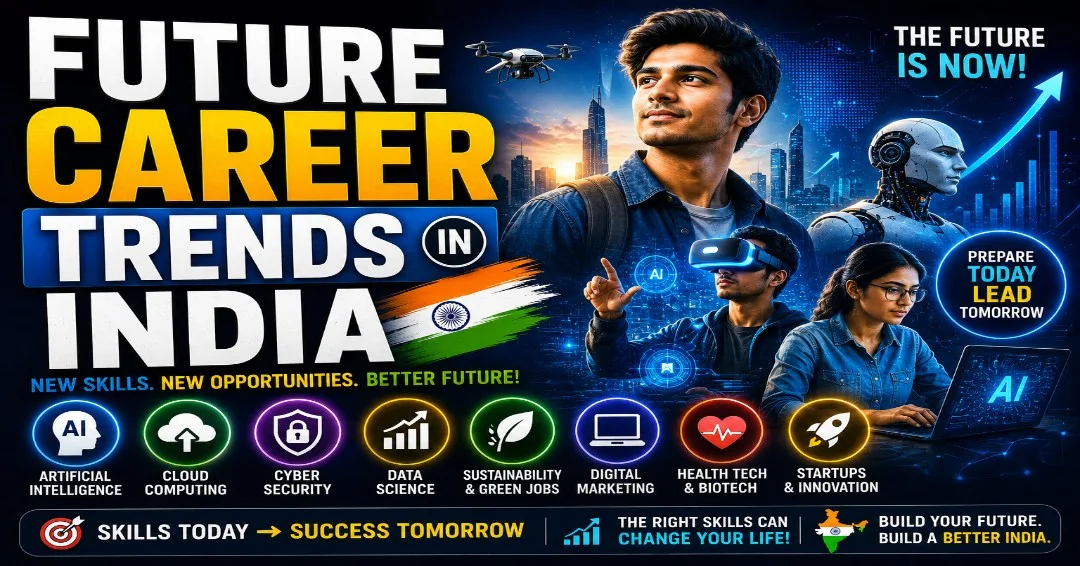
Future Career Trends in India
Join Our WhatsApp Channel for Latest UpdatesFuture Career Trends in India: What Students Should Know for 2026 and Beyond
India's job market is moving faster than most degree programs can keep up with. With over 65% of the population under 35, the country produces roughly 15 million new graduates every year — and the real challenge isn't a lack of jobs, it's a mismatch between what colleges teach and what employers now need.
The numbers back this up: India's white-collar hiring opened 2026 with a 12% year-on-year rise in February, and AI/ML job postings alone surged 34% in a single month. At the same time, the World Economic Forum projects that automation could displace 85 million jobs globally by 2030 — while creating 97 million new ones. India, with its massive young workforce, sits right at the center of that shift.
Here's a clear-eyed look at where the opportunities actually are.
1. AI and Machine Learning Are No Longer "Future" Skills — They're Current Ones
Generative AI has moved from experimental pilots to everyday execution inside Indian companies. AI/ML engineers, prompt specialists, and AI-integration roles are now hiring across IT, healthcare, banking, and even government sectors — not just tech startups. Senior AI architect salaries can range well into the ₹40–80 lakh bracket at the top end.
What matters more than the job title is the underlying shift: AI literacy is becoming as fundamental to hiring as basic computer literacy was a decade ago. Employers increasingly expect people to work with AI tools, not compete against them — which is why "a doctor who understands health tech, or an accountant who can work with AI tools" tends to have a real edge over someone with narrow specialist knowledge alone, as India Skills Report's Ritesh Singh has put it.
2. Cybersecurity: High Demand, Real Skill Gap
As more of India's economy moves online, cybersecurity has become one of the steadiest bets available. The skill gap here is wide, and senior professionals can earn between ₹20–38 LPA. It's also one of the more accessible fields for students from tier-2 and tier-3 cities, since entry-level roles reward certifications and demonstrated skill over pedigree.
3. Cloud Computing Keeps Expanding
Cloud infrastructure investment in India is creating an estimated 1.4 crore new jobs, and unlike many specialized tech fields, you don't need a computer science degree to break in — a solid certification alongside any engineering background is often enough to get started. Cloud architects in particular are in high demand as companies migrate faster than they can hire.
4. Data Science Remains a Strong, if Slower, Transition
Data science and analytics roles continue to pay well and hire steadily, but they take longer to break into — expect 6 to 12 months of serious, focused effort to make a credible switch. It rewards patience more than most fields on this list, but the payoff (mid-career salaries often in the ₹20–30 LPA range) tends to be durable.
5. Design Is Having a Genuine Moment
UX design, product design, and motion/gaming design have quietly become some of the highest-growth creative fields in India, driven by OTT platforms, app-first businesses, and a genuine shortage of skilled designers. This is a strong option for students who are creative but not necessarily drawn to coding — the field rewards problem-solving and user empathy more than technical depth.
6. Digital Marketing Stays Fresher-Friendly
Digital marketing continues to be one of the most reliable entry points for students without a technical background. Starting salaries typically range ₹4–12 LPA, and the field values portfolios and demonstrated campaign results over years of experience — making it a realistic switch in as little as 3 to 6 months.
7. Healthcare and Biotech: Steady, Recession-Resistant Growth
Healthcare is growing at roughly 16% annually and carries essentially zero risk of disappearing. For science-track students, biotech is an increasingly attractive adjacent field — spanning vaccine development, genetically modified crops, and pharma — with growing job creation across hospitals, food tech, and agriculture.
8. Supply Chain and Operations Are Quietly Booming
Post-pandemic, supply chain management became a genuine boardroom priority. Backed by India's PLI (Production Linked Incentive) manufacturing push and growth in pharma, FMCG, and electronics, operations roles now range from ₹6 LPA for freshers to ₹40 LPA for senior leaders — a field that rarely gets the spotlight but consistently delivers.
9. Renewable Energy Is Becoming a Real Career Path, Not Just a Cause
With EVs going mainstream and India investing heavily in solar and wind, renewable energy engineering is shifting from a niche interest to an active hiring category. Even students in Class 10–12 are starting to build relevant skills through workshops and DIY kits — a sign of how early this pipeline is forming.
10. Where the Risk Actually Is
It's worth being direct about what's not safe: the most vulnerable roles in India's job market are routine, middle-skill tasks — basic accounting, data entry, simple templated coding, and scripted customer support. These are exactly the tasks automation absorbs first. If your target career leans heavily on repetitive, rules-based work, it's worth asking how AI-resistant that specific role really is — not just the industry it sits in.
11. Beyond Job Titles: How Companies Themselves Are Changing
Two workplace shifts are worth knowing about even before you enter the job market:
- Internal mobility is replacing constant external hiring. Senior external hires now cost Indian companies ₹2–12 lakh in recruitment costs alone, with time-to-hire often exceeding 60 days. Companies are responding by investing in internal talent pathways — which means building a reputation and skill record inside your first employer can pay off faster than job-hopping.
Hiring is spreading beyond the big four tech cities. Roughly 32% of hiring now happens in tier-2 cities and 20% in tier-3 cities, with places like Pune, Ahmedabad, and Indore seeing 15–20% annual compensation growth. Students outside Bengaluru, Delhi, and Hyderabad have more real opportunity today than they did even a few years ago.
How Students Should Actually Use This
A trends list is only useful if it changes what you do next. A few practical takeaways:
- Pick a lane based on genuine fit, not just salary data. Cybersecurity and cloud both have low entry barriers and strong pay, but they suit different types of thinkers — one rewards vigilance and detail, the other rewards systems thinking.
- Layer a digital skill onto your core subject, don't abandon it. A commerce student who learns SQL, or a biology student who understands health tech, tends to out-compete narrow specialists in either direction.
- Use the next 30 days, not the next 3 years, as your planning unit. Pick one field from this list, spend a month exploring it seriously — a short course, a small project, a few informational conversations — and let that decide your next real step.
- Don't assume city matters as much as it used to. With hiring shifting to tier-2 and tier-3 cities, building a strong skill portfolio matters more than being based in a metro.
India's job market in 2026 isn't short on opportunity — it's short on candidates who've matched their skills to where demand actually is. The fields above aren't predictions; they're grounded in current hiring data and policy investment happening right now. The gap between a good outcome and a great one is mostly a matter of starting early and choosing deliberately.
💡 Why Choose CareerFlora?
Stay updated with the latest government jobs, admit cards, results, ETC, only on CareerFlora – Your Gateway To All Opportunities 🌱