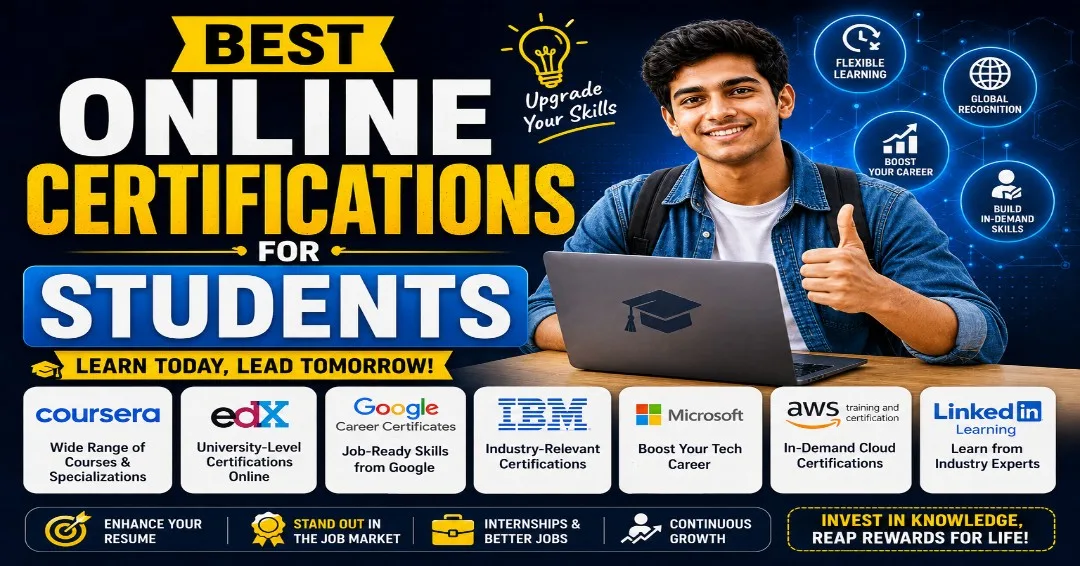
Best Online Certifications for Students in 2026
Join Our WhatsApp Channel for Latest UpdatesBest Online Certifications for Students in 2026
College tuition keeps climbing, but the job market increasingly rewards proof of skill over pedigree. Companies like Google, IBM, and Apple have dropped degree requirements for many roles, leaning instead on demonstrated abilities and recognized certificates. For students, that's good news: the right online certification, earned alongside a degree or on its own, can open doors that once required years of traditional schooling.
Here's a practical, up-to-date guide to the certifications worth your time in 2026 — organized by field, budget, and career goal.
Why Certifications Matter More Than Ever
Certificates work best when they connect to a real job function, come from an issuer employers actually recognize, and align with a clear career goal. Stacking five unrelated certificates for the sake of a longer LinkedIn profile rarely pays off — one or two well-chosen credentials that build toward the same goal do far more for your resume.
Before enrolling in anything, it's worth checking:
- Accreditation or industry recognition — does the issuer carry weight with employers in your target field?
- Alignment with a real exam or job title — is this preparing you for something specific (an exam, a tool, a role)?
Cost vs. time vs. payoff — some certificates cost nothing but a few weeks; others cost thousands and months.
Tech & IT Certifications
Technology remains the most certification-friendly field, since skills can be tested directly and employers trust third-party validation.
- Google IT Support Professional Certificate (Coursera) — A widely used entry point into IT, often used as a stepping stone toward cybersecurity or cloud roles within 12–18 months.
- Google Cybersecurity Certificate (Coursera) — Covers network security, threat detection, and security operations center basics. Roughly six months at under 10 hours a week, and one of the more accessible ways into entry-level security work without a degree.
- CompTIA Security+ — A go-to first certification for cybersecurity, typically requiring 80–120 hours of study. Strong foundation before pursuing more advanced credentials.
- AWS Certified Solutions Architect — Cloud computing remains one of the highest-paying skill areas; AWS-certified professionals report meaningfully higher average salaries than non-certified peers in similar roles.
- Microsoft Certified: Azure Solutions Architect Expert — Valuable if you're aiming at corporate IT, since a large share of enterprise environments run on Microsoft infrastructure. Requires the Azure Administrator Associate certification first.
CISSP (Certified Information Systems Security Professional) — A senior-level credential for those with existing experience, often associated with a significant pay premium and a path into security leadership.
Data, Analytics & AI Certifications
Data skills are in demand across nearly every industry now, not just tech.
- Google Data Analytics Certificate (Coursera) — One of the most enrolled professional certificates ever, teaching SQL, spreadsheets, and Tableau through hands-on projects.
- Google Professional Data Engineer — Considered one of the more lucrative certifications available to people without a traditional degree, particularly relevant as companies invest heavily in data infrastructure.
- IBM Data Science Professional Certificate (Coursera) — Covers Python, SQL, and machine learning fundamentals with project-based learning.
- Google AI Essentials — A beginner-friendly, non-technical introduction to AI tools and prompt engineering — useful for students in any major, not just computer science.
Andrew Ng's AI for Everyone — A widely respected primer for understanding how AI affects business and industry, aimed at non-technical learners.
Business, Project Management & Marketing
- Google Project Management Certificate (Coursera) — Introduces Agile and Scrum fundamentals; a solid low-cost entry point before pursuing PMP.
- PMP (Project Management Professional) — The credential itself is issued by the Project Management Institute after an exam; online prep courses (via Harvard Online or edX, for example) help you get there. It's one of the more prestige-heavy credentials for project managers.
- Google Digital Marketing & E-commerce Certificate — Covers SEO, social media, email marketing, and Google Ads — practical for students freelancing or running a small side business.
SHRM certifications (Human Resources) — Considered a gold standard in HR, though exam fees and prep time are a bigger investment.
Healthcare-Adjacent Certifications
- Certified Medical Assistant (CMAA) — Minimal prerequisites and a relatively quick path into healthcare administration work.
- AAPC Certified Professional Coder (CPC) — The leading credential for medical coding; often required or strongly preferred for coding jobs.
Health Informatics certificates (Coursera/edX, various universities) — Useful for students who want to blend healthcare knowledge with tech skills, an intersection that's growing quickly.
Free (or Nearly Free) Certifications Worth Considering
Not every student needs to spend money to build a credible resume line:
- freeCodeCamp — Completely free certifications in web development, JavaScript, and Python, with hands-on projects you can put directly on GitHub.
- Harvard's CS50 (edX) — Free, rigorous, and widely respected introduction to computer science and programming.
- HP LIFE — Free foundational courses in business and data skills, good for students without technical background.
Coursera financial aid or audit mode — Many of the paid certificates listed above (including Google's) can be accessed free through Coursera's financial aid option if you can't pay upfront.
How to Actually Get Value From a Certificate
A certificate alone rarely gets someone hired — but a certificate plus a small project does much more:
- Pick one track and stick to it. A Data track (Google Data Analytics → a Python project), a Web track (Meta Front-End → a portfolio site), or an AI track (AI Essentials → a small automation project) all work better than scattered, unrelated certificates.
- Build something to show for it. Employers respond far more to a small dashboard, app, or writeup than to a certificate name alone. Add it to GitHub or a portfolio site.
- Put it on LinkedIn correctly. Add it under Licenses & Certifications, pin the most relevant ones under Featured, and post a short summary of what you actually learned with a few keywords a recruiter might search for.
Match the certificate to a real job posting. Before committing time or money, search actual job listings in your target field and see which certifications employers mention. That's a much better filter than "best certifications" lists (including this one).
The Bottom Line
There's no single "best" certification — the best one is the one that maps to a job you actually want, from an issuer employers in that field recognize. For most students, a sensible starting point is one free or low-cost certificate in a growth area (data, cybersecurity, or AI) paired with a small project that proves you can use what you learned. Build from there rather than collecting credentials for their own sake
💡 Why Choose CareerFlora?
Stay updated with the latest government jobs, admit cards, results, ETC, only on CareerFlora – Your Gateway To All Opportunities 🌱