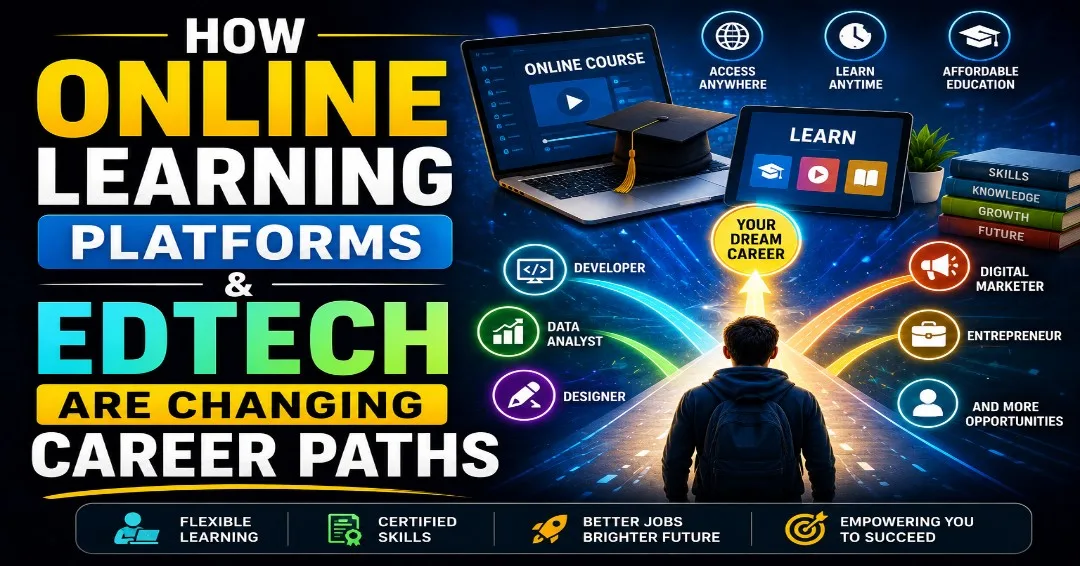
How Online Learning Platforms & EdTech Are Changing Career Paths
Join Our WhatsApp Channel for Latest UpdatesBeyond the Degree: How EdTech Career Development is Rewiring Your Path
The traditional career ladder isn't just broken—it’s being entirely rebuilt. For decades, the formula was rigid and predictable: secure a four-year degree, land an entry-level job, and slowly climb the ranks. Your major dictated your industry, and your alma mater often dictated your ceiling.
That playbook is officially outdated. The half-life of a learned technical skill is now estimated to be less than five years. In response, a massive shift toward EdTech career development is democratizing how we learn and, more importantly, how employers hire. We are moving away from pedigree and moving directly toward potential.
Whether you are a student mapping out your future, a job seeker looking for a pivot, or a seasoned professional trying to stay relevant, technology is changing the rules of engagement. Here is how education technology is fundamentally reshaping the modern career path.
1. The Unstoppable Rise of Skill-Based Hiring
We are witnessing a structural shift in human resources: the transition from degree-based filtering to skill-based hiring. Companies like Google, IBM, and Apple have explicitly dropped four-year degree requirements for a significant portion of their roles. They care less about where you spent four years and more about what you can actually execute on day one.
The Data: According to recent labor market reports, the number of job postings on LinkedIn omitting degree requirements grew by 36% between 2019 and 2022 (Note: Specific percentage requires verification against the latest 2024/2025 LinkedIn Economic Graph data).
This is where EdTech bridges the gap. By offering verifiable digital credentials and portfolio-building projects, platforms allow candidates to prove their competencies directly.
Explore the widget above to see how different industries are shifting their hiring priorities.
2. AI in Education: Your 24/7 Career Coach
Artificial intelligence isn't just automating jobs; it’s accelerating how we prepare for them. AI in education has evolved far beyond automated grading systems. Today, we have adaptive learning algorithms that act as personalized, 24/7 tutors.
If you are learning to code and keep stumbling on a specific Python concept, an AI tutor doesn't just hand you the answer. It analyzes your failure points, adjusts the difficulty, and generates custom exercises to help you master that exact bottleneck.
This level of hyper-personalized learning used to require expensive, one-on-one human tutoring. Now, EdTech career development tools use large language models to simulate mock job interviews, critique your resume in real-time, and suggest specific courses based on real-time gaps in your industry's job market.
3. Micro-Credentials and the "Stackable" Resume
The era of “one and done” education is over. The future belongs to lifelong learners who build "stackable" credentials. Online learning platforms like Coursera, edX, and Udacity have partnered directly with industry giants to create specialized, bite-sized certifications.
Programs like the Google Data Analytics Certificate or the Meta Front-End Developer Professional Certificate are designed to take someone from zero experience to job-ready in under six months.
Instead of a single, static line item on a resume, candidates are building dynamic portfolios. You can stack a core marketing degree with a micro-credential in AI prompt engineering and another in data visualization. This modular approach allows you to pivot your career trajectory in months rather than years.
4. Remote Learning as the Blueprint for Remote Work
There is a hidden, secondary benefit to the boom in EdTech: the medium is the message. By mastering online learning platforms, you are simultaneously mastering the exact soft skills required for the modern, distributed workplace.
Navigating asynchronous coursework, collaborating with peers across different time zones via digital whiteboards, and self-managing your deadlines are no longer just study habits. They are the core competencies of remote work. Employers recognize that a candidate who has successfully upskilled through rigorous, self-directed EdTech platforms possesses the discipline and digital fluency needed to thrive in a hybrid work environment.
Practical Takeaways: How to Future-Proof Your Path
Knowing the landscape is shifting is only half the battle. Here is how you can actively leverage EdTech career development to your advantage today:
- Audit Your Skills Annually: Treat your skillset like a software product. What needs an update? Look at job descriptions for roles you want in two years and identify the gap between your current skills and their requirements.
- Embrace Micro-Learning: You don't need to commit to a master's degree to pivot. Dedicate 20 minutes a day to a specific micro-credential on an online learning platform. Consistency compounds.
- Show, Don't Just Tell: Certificates are great, but portfolios are better. Use platforms like GitHub, Kaggle, or Behance to publicly host the projects you build during your online courses.
Learn to Work with AI: Don't compete with AI; learn to pilot it. Take courses specifically focused on AI literacy within your niche—whether that's AI for copywriting, financial modeling, or HR.
Conclusion: The Never-Ending Syllabus
Technology has fundamentally rewritten the social contract of work and education. We are no longer students for four years and workers for forty. We are perpetual learners.
The most valuable skill you can cultivate today isn't a specific programming language or a management framework—it is the meta-skill of adaptability. EdTech career development provides the tools, the platforms, and the pathways. The only question remaining is: what are you going to learn next?
💡 Why Choose CareerFlora?
Stay updated with the latest government jobs, admit cards, results, ETC, only on CareerFlora – Your Gateway To All Opportunities 🌱